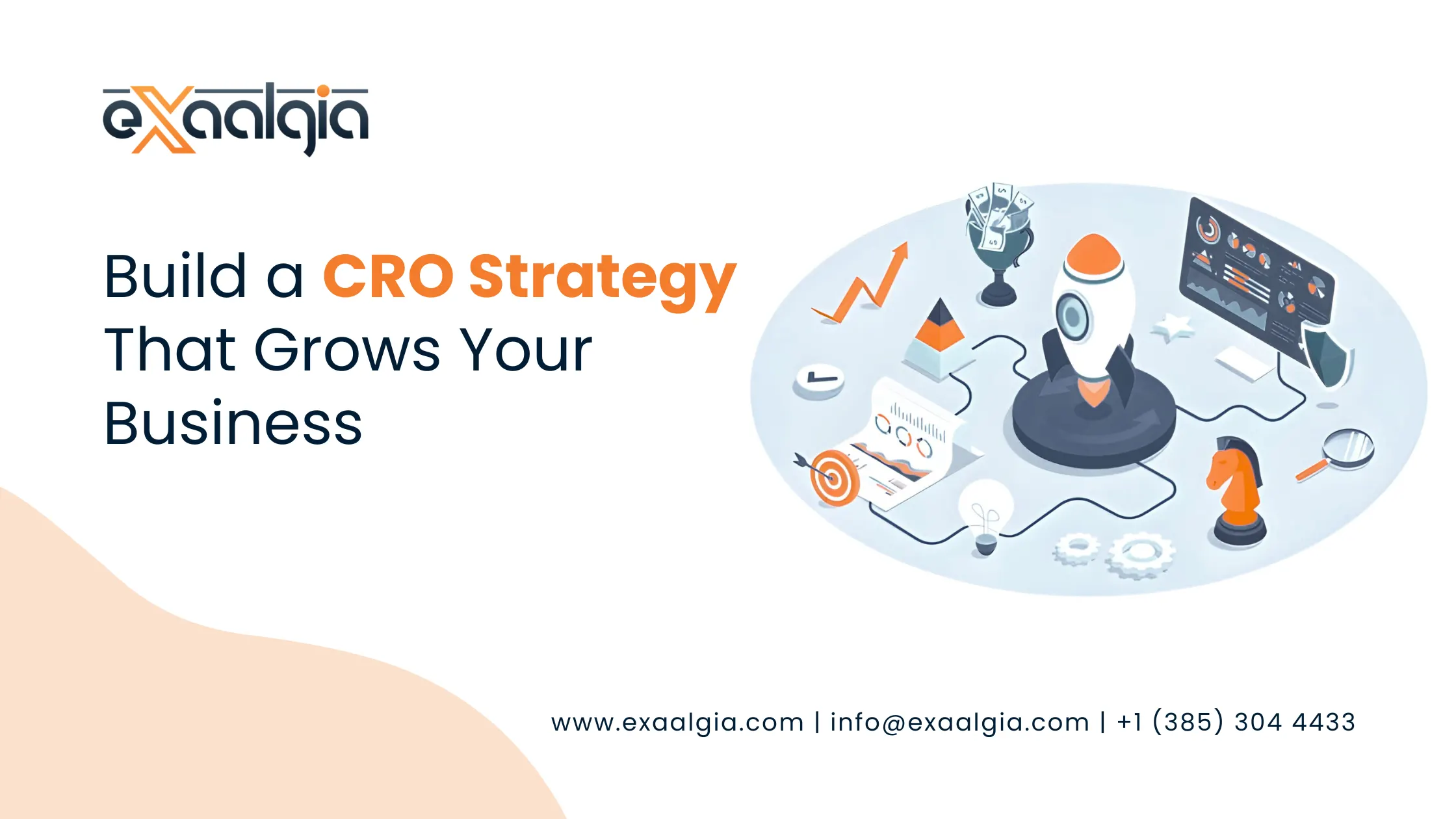
Conversion rate optimization (CRO) is not a guesswork project. It is about knowing how users act, eliminating friction, creating an experience so smooth that visitors just take action naturally.
We are going to provide the structure that we apply to assist high growth businesses in this comprehensive guide. You will know how to construct a CRO strategy that really works, a CRO strategy that drives conversions, drives more revenue, and generates steady, predictable growth to your business.
What Is A CRO Strategy and why is it important?
CRO strategy can be viewed as a well-organized, data-driven approach aimed at raising the part of web site visitors that undertake a desirable activity, like buying a product, entering a form, or placing a call.
CRO is the lever of growth that is most important to any business that cares about profitability.
An effective CRO models benefits your company:
- Grow sales without growing traffic.
- Optimize ROI in SEO, PPC, and social campaigns.
- Lessen the expenses of customer acquisition.
- Improve user experience and loyalty.
- Also know what is working- and correct what is not.
In simple words:
Traffic is the fuel and CRO is the engine that can convert traffic to revenue.
In the modern competitive digital economy, it can no longer be overlooked by businesses, particularly, eCommerce and service oriented brands.
Define Your Primary Conversion Goal
Every successful CRO strategy is founded on the basis of establishing the goal first.
The thing to ask before you start optimizing anything is:
“What is the most desirable action we can get our visitors to do?”
Some of the primary goals that can be considered are:
- Buy a product
- Complete a lead form
- Schedule a consultation
- Register for a demo
- Become a newsletter subscriber
You have no means to evaluate success or develop a structured optimization plan if you have not defined the goal.
Secondary Goals Matter Too
The secondary actions play a part in conversion as well:
- Add to cart
- Open pricing page
- Get a guide
- Talk to the chatbot
Monitoring these minor actions provides a better understanding of the user behavior.
Recognizing the Behavior of Your Audience
The first step in the optimization process is understanding.
In the process of optimizing conversion rates, the main rely is behavioral data and not speculative assumptions.
The following are the main tools that can assist:
- Google Analytics – user flow, rate of abandonment, trails of conversions
- Hotjar/Clarity – heatmaps and session recordings
- Surveys/Polls – insights that are qualitative
- User testing – analysis of real world friction
Direct your focus towards the questions of:
- At what stage do users abandon the process?
- Which pages induce the most friction?
- What factors lead to misunderstanding?
- What reasons drive the users to take action?
If you know the reason for not converting, it is much easier to fix the problem.
Conduct a Full Funnel Audit
A CRO strategy needs to cover all steps of the user journey, which includes all the touches from landing on your website to making a purchase.
Audit Key Points:
1. Top of the Funnel (Awareness)
- Does the landing page correspond to the ad intention?
- Are your headlines transparent and benefiting the customer?
- Is the search intent compatible with your SEO pages?
2. Middle of the Funnel (Consideration)
- Do the customers get your value proposition?
- Are the benefits, features, and social praise visible?
- Is your communication clear and constant?
3. Bottom of the Funnel (Conversion)
- Is your call to action noticeable and attractive?
- Are the forms lengthy or unclear?
- Are the checkout processes overly complex?
The majority of conversion losses happen in the middle and bottom parts of the funnel, but structured audits make it very easy to pinpoint the exact areas of the problems.
Create Hypotheses Based on the Data
After spotting the gaps, let each insight be a hypothesis that you can test.
A well-formulated hypothesis is:
“If we modify X, it will bring about Y, for Z is the reason.”
To illustrate:
- By reducing the length of the checkout form, the number of users completing the purchase will rise as the friction in their experience gets reduced.
- With the addition of testimonials right above the CTA, the trust of visitors will increase and thus, they will more likely click the button.
- In case the headline is rewritten to highlight the benefits, the engagement will grow as the users will be able to comprehend the value quicker.
The approach of hypothesis driven optimization eliminates arbitrary changes made for the sake of it and makes sure that learning is the same everywhere.
Prioritize Changes Using the ICE or PIE Framework
The ideas for CRO do not have the same effect. Some ideas will bring a considerable impact, while others will have a slight one.
For prioritization, you can apply the following:
ICE Score
Impact: What impact will this change have on conversion rate?
Confidence: What is the degree of certainty of our prediction?
Ease: What is the difficulty level of the implementation?
PIE Score
Potential: Area where it could be improved
Importance: Amount of traffic
Ease: Difficulty in implementing
The high-impact, low-effort changes that yield quick wins are the ones that you start with.
Test Your Changes (A/B Testing)
A/B testing is the core of a successful CRO strategy.
You do not rely on guesses, you rely on testing.
A/B Test May Include The Following Factors:
- CTA text (e.g., Get Started vs. Book Your Free Audit)
- Hero headlines
- Form fields
- Page layout
- Button placement
- Trust badges or reviews
- Pricing page variations
A/B Testing Tools:
- Google Optimize (sunset but alternatives exist)
- VWO
- Optimizely
- Unbounce (for landing pages)
Don’t Forget:
Test one element at a time.
If you test too many things at once, you won’t know what caused the change.
Analyze the Results
Post-testing, the next step is to analyze the following:
- The lift in conversion rate
- The increase in time spent on the page
- Changes in bounce rate
- Scroll depth
- The rate of form completion
- Impact on revenue
Do not cut off the tests prematurely. They should be allowed to continue until the difference between the groups is proven to be indeed significant, which may take 2-4 weeks, depending on the level of site traffic.
In case one variation proves to be better, then it should be made a part of the site permanently.
If it turns out to be a losing variation, then learn from the outcome of the test and come up with a new hypothesis for testing.
The whole cycle of testing → learning → improving is precisely what makes CRO so powerful.
Enhance Your Landing Page Experience
The foundation of an effective CRO strategy is the landing page with the highest conversion rates.
Main Elements that Boost Conversion:
1. Simple, Specific, and Value Focused Headline
Powerful, Benefit-Driven Headline.
2. An Attractive Subheadline
Tell us about your offer and its significance.
3. Social Proof
Reviews
Research
Recognition from the industry
Logos of clients
4. An Unambiguous CTA
One primary call-to-action for every section.
5. Visual Hierarchy
The most crucial components should be noticeable.
6. Instant Loading
A delay of 1 second can cause a loss of up to 7% in conversions.
Landing pages are often the site of multiple conversions, and their optimization can cause a radical improvement in results.
Minimize User Friction on Your Site
Friction negatively impacts conversions and therefore, removing all the factors that confuse, overwhelm or slow down users, will be your main goal through the CRO strategies.
Ways to Reduce Friction:
- Making the process of navigation easier
- Filling in fewer fields in forms
- Getting rid of unnecessary pop-ups
- Enhancing the responsiveness of mobile devices
- Providing payment options in different ways
- Being clear and honest about the pricing
Users can drop out because of a very minor friction point, particularly when using mobile devices.
Make CRO an Ongoing Process (Not a One-Time Fix)
What is the most significant mistake in CRO that companies make?
To consider it as an occasional event.
The right CRO strategy is:
- Permanent
- Based on data
- Repetitive
- Flexible
- Never failing to rejuvenate
Consumer patterns shift. Search intention shifts. Tech also shifts.
Your CRO needs to change along with them.
Companies that do A/B testing regularly receive an increase in their customer base every month.
Why Brands Choose Exaalgia for CRO Strategy
Exaalgia’s CRO strategy is the main reason why many well known companies pick them as partners.
Simply put, we at Exaalgia are equipped to draw out the hidden revenue of the companies through our state of the art conversion rate optimization (CRO) frameworks that by:
- Bringing in more sales
- Making the user experience better
- Matching user intent with the brand’s message
- Lowering costs for gaining new customers
- Making the whole marketing funnel stronger
If you’re operating an eCommerce store or a SaaS platform or a service based company, our CRO strategies will give you results that are not only measurable but also sustainable over time.
Key Takeaways on CRO Strategy
A successful CRO approach is constructed from data and not from conjectures.
If you stick to a structured framework, observation of user behavior, hypothesis formulation, running variations, and optimization, then your site will be able to generate revenues.
Visitor traffic is good. Sales are even more important. But you can be sure of both with a solid CRO plan.
Frequently Asked Questions (FAQs)
1. What is the most critical issue that companies face when adopting a CRO Strategy?
The most critical issue is going for testing without a well-established hypothesis that is supported by data. A lot of companies go directly to testing the subjective aspects (such as changing the colors) without doing a quantitative and qualitative audit first that would reveal the real user friction points. A successful CRO strategy must go to the bottom of the issue of non-conversion and not just point out the areas of interest of the users.
2. When can I expect to see the results from a new CRO Strategy?
The period varies, but usually, the significant results can be seen during the period of 2 to 4 months of regular testing. The first phase consists of gathering data, auditing, and setting the testing environment. After that, each A/B test has to be run for at least 2 to 4 weeks to reach statistically significant results and to balance the variations in traffic for the week. For the highly trafficked sites, reliable results can be obtained faster, however, being patient and following the statistical process is very critical.
3. Should I give preference to the mobile site testing or the desktop site testing?
The version of your site (mobile or desktop) which has the biggest gap between its traffic volume and its conversion rate should be the one you prioritize. Since most web traffic nowadays comes from mobile, you must first start by looking into mobile user behavior. For instance, if 70% of your traffic is from mobile but only 30% of your conversions come from mobile, then your CRO strategy should put a lot of emphasis on improving the mobile experience (page speed, touch targets, and form usability).
4. How frequently should a business conduct A/B tests in order to keep a strong CRO Plan?
A winning CRO plan is based on relentless, iterative testing. The aim should be to have an always active testing roadmap where the next test is started at the same time the previous one ends. This could mean for high traffic sites running tests all year round, twenty-four seven. Optimization is not a one-off project; it is a permanent method of working aimed at getting constant and very small improvements.
5. What distinguishes a CRO from UX/UI design?
UX/UI Design is all about creating a website that is easy to use and good-looking. CRO, on the other hand, is concerned with making the site effective and persuasive, going straight for a measurable business goal (conversion) with its tactics. While good UX/UI design is a necessary condition for CRO, a CRO strategy employs A/B testing, data, and psychological principles to determine which design components or changes in messaging actually attract more customers and generate more revenue.