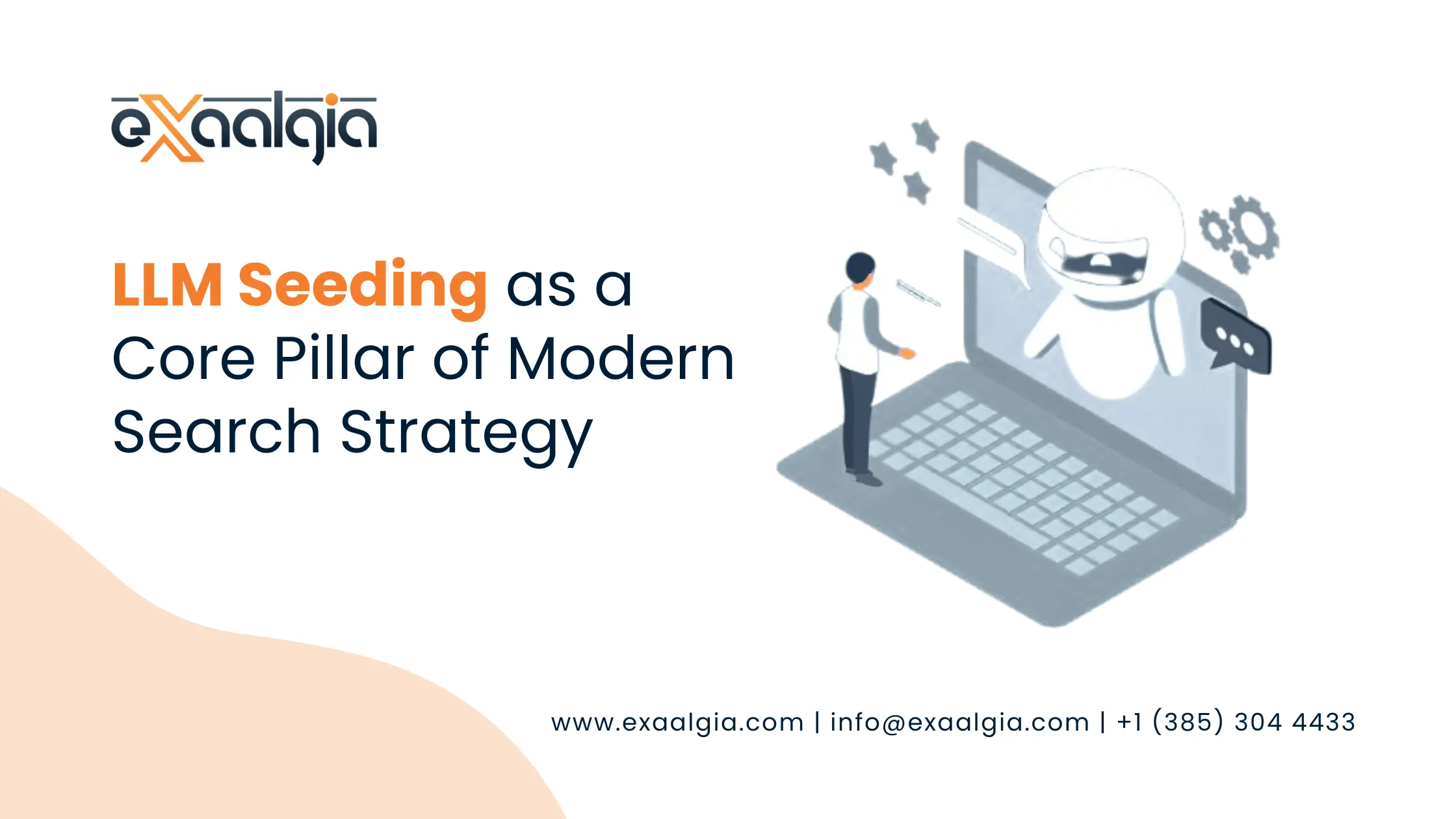
In this new “conversational” economy, showing up in a list of blue links is no longer enough. You need to be the answer the AI provides. This is where LLM seeding becomes the most critical weapon in your marketing arsenal.
What Is LLM Seeding and How Does It Work?
LLM seeding is the strategic process of creating, publishing, and distributing high-quality, structured content across specific digital ecosystems to ensure it is ingested, prioritized, and cited by large language models (LLMs).
Think of the internet as a vast field. Traditional SEO is like building a tall sign (your website) and hoping people walk past it. LLM seeding, however, is like planting seeds in the soil that the AI uses to grow its knowledge. By placing facts, definitions, and expert opinions on platforms that AI models “trust” and “crawl” frequently, you are essentially “hard coding” your brand into the AI’s memory.
At its core, LLM seeding focuses on semantic association. It’s not just about keywords, it’s about ensuring that when an AI thinks of “best cloud security for fintech,” your brand name is mathematically linked to that concept within the model’s latent space.
Why Modern SEO Needs LLM Seeding
Traditional SEO is evolving into GEO (Generative Engine Optimization). Here is why seeding is the bridge to the future:
1. Increasing Brand Presence Inside AI-Generated Responses
When a user asks, “Which CRM is best for real estate agents?” the AI doesn’t give them 10 links, it gives them a paragraph. If you haven’t seeded the web with content that links your brand to “real estate CRM,” you won’t even be mentioned. Seeding ensures you are part of the generated narrative.
2. Establishing AI Trust Through Strategic LLM Seeding
LLMs are programmed to avoid “hallucinations” by citing credible sources. By seeding your expertise across multiple reputable platforms, you create a “consensus signal.” When multiple high authority sites say the same positive things about your brand, the AI treats it as a verified fact rather than a marketing claim.
3. Navigating Zero-Click Searches with AI-Focused Content
With AI overviews (SGE) and ChatGPT, over 60% of searches now end without a click to a website. LLM seeding allows you to capture value from these “zero-click” sessions by building brand awareness directly within the AI’s interface.
4. Expanding Search Visibility Beyond Google Rankings
Traditional SEO is a “winner takes all” game for the top three spots. LLM seeding allows smaller, more specialized brands to gain visibility. If your content is the most “citable” or “structured,” an AI may choose you over a massive competitor that has more backlinks but less clear information.
5. Turning AI Mentions into Direct Brand Searches
When an AI mentions your brand as a top recommendation, it triggers “branded search.” Users will then go to Google and search for your brand specifically. This creates a virtuous cycle that boosts your traditional SEO rankings as well.
The Role of LLM Seeding in ChatGPT Content Recognition
ChatGPT and similar models are trained on massive datasets like common crawl, WebText2, and specialized scrapes of the high authority web. However, models aren’t “static” anymore; they are constantly updated through:
- Pre training Cycles: Large, periodic updates where the model learns from the “open web.”
- Fine Tuning: Targeted training on high quality datasets (like Reddit or academic journals).
- RAG (Retrieval-Augmented Generation): Real time web browsing (used by ChatGPT Plus, Perplexity, and Gemini) to find the most current information.
The Ingestion Pipeline
By seeding content on high authority “seed sites” (like LinkedIn, Medium, or Tier-1 news outlets), you increase the probability that AI crawlers, such as GPTBot or Google other, will prioritize your content during their next ingestion cycle. The AI doesn’t just “see” your page; it calculates the fact density and information gain. If your content provides a unique fact or a structured comparison that doesn’t exist elsewhere, the LLM identifies it as a valuable “data point” to be stored for future use.
Can My Brand Show Up in Claude or Gemini AI Answers?
Yes. While each model has a different “personality” and training set, they all rely on the same fundamental principles of high quality data ingestion. Improving your LLM visibility on these platforms requires a multi-pronged approach that targets both static training sets and real-time retrieval systems.
- Gemini: As a Google product, Gemini is heavily influenced by Google’s knowledge graph and your existing SEO authority. Seeding through Google owned or Google favored platforms (YouTube, Google Business, and Tier-1 News) is key.
- Claude: Developed by anthropic, Claude prioritizes safety, nuance, and long form reasoning. Seeding whitepapers, deep dive technical articles, and nuanced “thought leadership” on LinkedIn or Substack works best for Claude.
- Perplexity: This is an “answer engine” that relies heavily on real time citations. Seeding Reddit, Quora, and niche forums is the most effective way to appear in Perplexity’s citations.
Key LLM Seeding Tactics for GEO Success
Generative engine optimization is the tactical application of LLM seeding. To succeed, you must move from “keyword targeting” to “entity targeting.”
Information Gain Analysis: Don’t just repeat what’s on the web. Add a new statistic, a unique case study, or a counter intuitive opinion. AI rewards “new” information.
Semantic Chunking: Break your content into 40-60 word “chunks” that directly answer a specific question.
Structured Data Domination: Use JSON-LD Schema (FAQ, Product, Review) to tell the AI exactly what your content is about in a language it speaks fluently.
Why LLM Seeding Requires a New SEO Mindset
| Feature | Traditional SEO | LLM Seeding (GEO) |
| Primary Goal | Rank #1 on SERPs | Get cited in AI responses |
| Core Metric | Clicks and Traffic | Brand mentions and Citations |
| Key Factor | Backlink Authority | Fact Density & Information Gain |
| Target | Human Searchers | AI Crawlers & Reasoning Engines |
| Content Style | Keyword-optimized blogs | Structured, cite-worthy data |
Understanding the LLM Seeding Process for GEO
The workflow of a successful seeding campaign follows a “source, distribute, reinforce” model:
Step 1: The Source of Truth. Publish a definitive guide or research paper on your own domain. Ensure it uses H2s and H3s as questions.
Step 2: Distribution (The Seeding). Repurpose that data into a Reddit post, a LinkedIn article, and a press release. Each platform adds a “layer” of credibility.
Step 3: Verification. Use “brand radar” tools or manual prompts to see if AI agents are starting to cite your new data.
The cycle of LLM optimization ensures that your content remains relevant even as models are updated or fine-tuned over time.
Content Sources That LLMs Trust the Most
Not all platforms are created equal. Here is where the “AI bots” go to school.
1. The Role of Publishing Platforms in AI Visibility
These platforms provide clean, semantic HTML that is incredibly easy for LLMs to parse. Because they are “walled gardens” of expertise, LLMs view content here as more authoritative than a random WordPress blog.
2. Editorial Content as a Core LLM Seeding Asset
Getting mentioned in TechCrunch, Forbes, or a niche trade journal (e.g., Construction Dive) acts as a “trust anchor.” When an LLM sees your brand mentioned here, it “locks in” your authority on that topic.
3. Using Community Platforms for LLM Seeding
Forums like Quora and Stack Overflow are goldmines for LLMs because they are structured in a “question-answer” format, the exact way users interact with AI.
4. Building AI Mentions Through User Reviews
Platforms like G2, Capterra, and Trustpilot provide the “sentiment data” AI needs. If a user asks “What are the pros and cons of Exaalgia?”, the AI pulls directly from these review clusters.
5. How Niche Microsites Strengthen AI Authority
Creating small, highly focused sites allows you to dominate a niche semantic space without the “noise” of a large corporate website.
6. GitHub as a Trusted Source for LLMs
For developers and SaaS, GitHub is a primary training source for models like OpenAI’s Codex. Seeding discussions here ensures your technical solutions are recommended to developers.
7. Social Platforms That Influence LLM Citations
While most social media is too “noisy,” X (Twitter) and LinkedIn are frequently crawled for real time trends and professional insights.
How to Optimize Content for AI Answer Engines
To be “citable,” your content must be structured like a textbook, not a diary.
1. How List-Based Content Supports LLM Extraction
Use bulleted lists with clear headers.
Example:
- Feature A: Description.
- Feature B: Description.
AI can easily “snip” this and put it into its own response.
2. How Original Insights Strengthen AI Visibility
Use phrases like “Our tests showed…” or “In my 10 years of experience…” LLMs are programmed to look for Experience (the first ‘E’ in E-E-A-T).
3. Comparison Tables as a Key LLM Seeding Format
Tables are the “holy grail” for GEO. They allow an AI to compare your brand against competitors instantly. If you provide a fair, data backed table, the AI is likely to display it directly in the chat.
4. Why AI Models Prefer FAQ-Style Content
Most AI prompts are questions. If your H2 is “How do I seed an LLM?” and your first sentence is the answer, you’ve done the AI’s job for it. It will reward you with a citation.
5. Why Expert-Led Content Earns AI Citations
Include “expert quotes” from real people with LinkedIn profiles. AI checks the “entity” of the author to verify if they are a real expert.
6. How Visual Content Enhances AI Interpretation
Use descriptive alt text and captions. While LLMs primarily process text, they use image metadata to “verify” the context of a page.
7. How Free Tools and Resources Drive AI Mentions
Templates, calculators, and PDF guides are often shared on other sites. Each share creates a new “seed” or mention that the AI tracks back to you.
8. How Practical Examples Increase LLM Trust
Generic: “Our software is fast.”
Citable: “Our software reduced latency by 45% for a team of 500 users.”
The latter is a “fact” the AI can use to back up its claims.
Core Benefits of Implementing LLM Seeding
Increased AI Visibility
Your business is included in the AI-generated responses over the following channels:
- ChatGPT
- Perplexity
- Gemini
- Claude
- AI-powered search assistants
Stronger Brand Authority
People will trust your brand without even clicking on your links if the AI tools keep on quoting your insights.
Sustainable Long-Term Impact
Content that has been seeded can even prolong its effect on LLMs for months or years, a period that cannot be claimed for ads or short term rankings.
Alignment With Future Search Behavior
LLM seeding positions your brand where search is heading, not where it has been.
Lower Customer Acquisition Cost
AI recommendations act as “warm leads,” resulting in higher conversion rates.
Why Better Seeding Leads to Better AI Answers
It is quite remarkable that when brands provide the web with proper, structured data, the models in return gain much better performance. They improve in accuracy and still are planes less likely to hallucinate in that particular area. Through seeding, you are not only advertising, you are playing a role in the “ground truth” of the AI.
Why LLM Seeding Often Fails
The Inconsistency Trap: If your website says one thing and your Reddit post says another, the AI will get “confused” and stop citing both.
Over Optimization: Writing “for the bot” so much that a human finds it unreadable. (Google still cares about human engagement!)
Ignoring Negative Seeds: One viral negative review on a high authority site can “poison” your AI reputation for months.
FAQs
Q: Is LLM Seeding the same as SEO?
A: No, LLM seeding and traditional SEO are not the same things, although the latter is mostly dependent on the former.
While SEO‘s main goal is to push the web pages up the search results via the use of keywords, backlinks, and technical optimization, LLM seeding applies the opposite approach by making sure that your brand, knowledge, and content are not only understood but also remembered and referenced by Large Language Models like ChatGPT, Gemini, Claude, and Perplexity.
LLM seeding instead of just focusing on rankings is actually working towards AI recall and citation. The end goal is not only to be on the results page but also to have the AI systems influence the user’s opinion through the answers generated, this continues even in the scenarios where there are no clicks and the user does not visit the site.
To sum up:
- SEO does the hard work of getting people to visit your site
- LLM seeding makes sure AI models are well aware of your existence
Q: Does LLM Seeding cost money?
A: LLM seeding can be budgeted or not, it all depends on the platforms and strategies you choose.
Among the paid techniques the following are most commonly used:
- Access to media coverage through PR campaigns
- Posting on high-trust industry publication sites
- Buying space for articles on big media outlets
Undoubtedly, these days, such methods can make visibility a lot faster since the LLMs trust the best and the most authoritative sources the most.
But still, money is not a necessity for LLM seeding to begin. There are free platforms such as:
- Reddit (with high-quality users)
- Posting of thought leadership articles on LinkedIn
- Publishing on platforms like Medium or Substack
- Participating in discussions in community forums or Q&A sites
The above might be less visible at the beginning but once done regularly and with proper strategy, can be quite powerful.
The main input in LLM seeding is the skill, the constancy, and the quality of the content, not just the budget.
Q: How do I track my LLM visibility?
A: Tracking LLM visibility is a different process from tracking traditional SEO rankings. Instead of monitoring keywords’ positions, you will be measuring AI’s mentions, citations, and brand recall.
You can monitor LLM visibility via:
Tools designed for AI visibility like SearchAtlas, Brand Radar, or other similar services which track the mentions of a brand in replies generated by AI
Testing manually, for example, using incognito or neutral prompts in applications like ChatGPT, Perplexity, and Gemini to find out if your brand has come up organically
Signals that are indirect, such as the rise in branded search queries, direct traffic, and referral traffic from AI sites
Since AI models are in a constant state of change, it is necessary to consider LLM visibility tracking as a normal routine. Timely supervision not only helps you to improve your seeding plan but also to find out which platforms and content types are getting the most AI recognition.
How LLM Seeding Changes Modern Content Strategy
In conclusion, LLM seeding is not just a “tactic”, it is a fundamental shift in how we think about the internet. We are moving from a world of “search” to a world of “answers.” By planting your seeds today, you ensure that when the AI of tomorrow is asked for a recommendation, your brand is the first name it speaks.