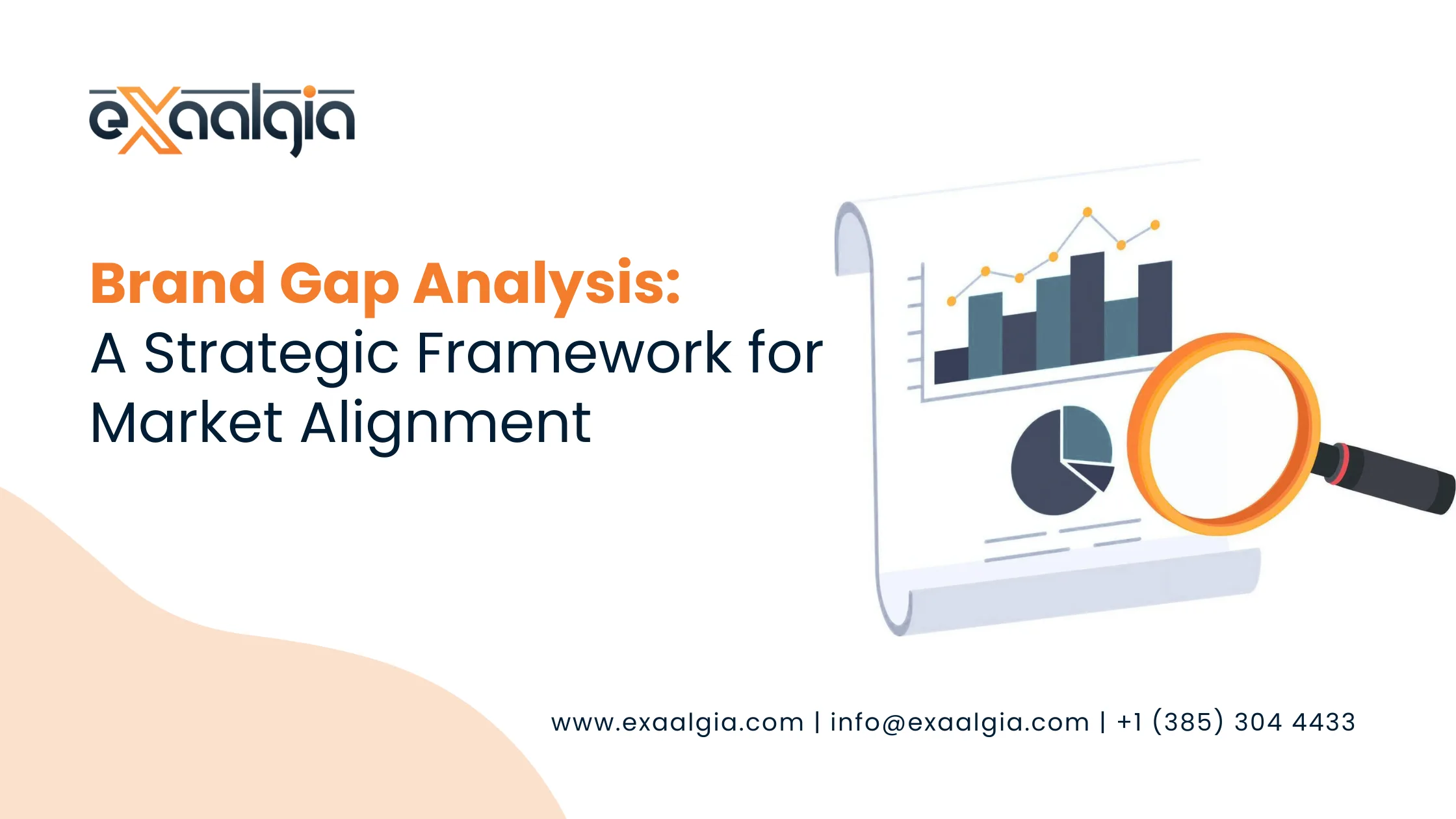
Over the last few years, businesses invest heavily in design, campaigns, and content, but they still face challenges with achieving visibility and establishing authority and creating their unique brand identity. The issue usually isn’t effort. The problem exists because different groups work in different directions. A brand gap analysis shows the specific areas where two brands fail to achieve proper alignment.
If your competitors are gaining traction while your brand feels stuck, there’s a gap between your actual market position and your intended brand positioning in the eyes of consumers.
Let’s break this down properly.
So, What Exactly Is a Brand Gap Analysis?
A brand gap analysis operates as a systematic evaluation method which measures the difference between your planned brand identity and the actual brand performance. The study creates a unified framework which investigates customer perception, market positioning, online search visibility, brand authority indicators, and user experience.
Instead of asking, “Do we have good branding?”, it asks deeper questions:
- Are we visible where our audience searches?
- Does our messaging reflect our actual value?
- Do customers perceive us the way we intend?
- Are competitors controlling conversations in our space?
The process combines three elements which include competitive benchmarking and digital visibility review and positioning assessment. The process overlaps with both keyword gap analysis and content gap analysis but extends its scope to include perception and authority assessment and narrative consistency evaluation.
Ultimately, it answers one critical question: Where are we losing ground, and why?
The Six Gaps That Could Be Costing You Growth
A meaningful evaluation doesn’t look at branding in isolation. It studies multiple layers of visibility and alignment.
Visibility Gap
The visibility gap measures how discoverable your brand is across search engines and AI-driven platforms. If your competitors consistently appear in top search results, featured snippets, or AI summaries while your brand remains absent, you’re facing a visibility problem.
This often stems from weak topical authority, inconsistent optimization, or insufficient digital PR efforts. Visibility is not only about traffic; it reflects authority and relevance in your industry.
Narrative Gapre
The narrative gap appears when your messaging changes from one channel to another. Your website may emphasize expertise, while your social content focuses on affordability. Your sales team may describe your services differently from your marketing materials.
When the story shifts depending on where customers interact with you, trust declines. Strong brands communicate a consistent narrative across every touchpoint.
Topic Gap
A topic gap exists when competitors dominate subject areas that your brand has barely explored. Even if you claim to be an industry expert, limited coverage of high-intent topics weakens credibility.
Search engines reward depth. If your competitors have built comprehensive topic clusters and semantic coverage while your content remains surface level, your authority will naturally lag behind.
Format Gap
Modern audiences consume information in various formats. If competitors are leveraging video, case studies, whitepapers, or interactive tools like chatbot, Semrush while you rely solely on blog posts, you create a format imbalance.
Different formats expand reach and engagement. Ignoring them restricts discoverability and audience connection.
Web Mentions Gap
Authority is reinforced externally. Media mentions, backlinks, interviews, and citations signal trust. If competitors are frequently referenced across reputable platforms while your brand receives minimal external recognition, your credibility gap widens.
Search algorithms interpret third-party validation as proof of authority. Without it, ranking improvements become difficult.
Demand Gap
The demand gap measures brand awareness. If users search for competitors by name more often than your brand, you’re facing an awareness issue rather than just an SEO problem.
Branded search volume, direct traffic trends, and recall surveys can reveal whether your positioning resonates strongly enough to generate demand.
Indicators That Your Brand Needs Strategic Evaluation
Certain patterns indicate it’s time to evaluate your brand alignment.
Inconsistent Messaging
When your homepage says one thing, your social media says another, and your email campaigns say something entirely different, customers struggle to understand your core value.
Inconsistent messaging reduces clarity and weakens conversion rates.
Poor Customer Experience
If reviews mention unmet expectations, unclear communication, or confusion about your offerings, that signals a gap between promise and delivery.
Brand perception is shaped by experience, not intention.
Lack of Differentiation
If customers compare you directly with competitors and struggle to explain what makes you unique, you likely have a positioning gap.
Strong brands clearly articulate their competitive advantage. Weak positioning blends into the background.
Why AI Search Isn’t Mentioning Your Brand
AI search is rapidly influencing how users discover brands. If your business isn’t appearing in AI-generated answers, the issue usually lies in authority, structure, or entity recognition.
Here’s how to diagnose it.
1. Structuring Brand Identity for AI Recognition
Your brand should be clearly associated with:
- Core services
- Industry categories
- Founders or leadership
- Signature methodologies
Structured data, consistent NAP details, and topical consistency strengthen entity recognition in AI systems.
2. Share of Voice and Search Benchmarking
Measure:
- Share of voice
- Keyword rankings
- AI-generated brand mentions
- Branded vs. non-branded traffic
Without a benchmark, improvement is guesswork.
3. Identifying Unranked High-Intent Keywords
A competitive keyword gap analysis reveals missed opportunities.
These may include:
- Commercial intent keywords
- Informational queries
- Long-tail semantic variations
Filling these gaps increases discoverability and authority.
4. Evaluating AI-Generated Mentions
Search AI platforms with queries relevant to your industry.
Observe:
- Which brands are mentioned
- Which sources are cited
- What type of content is referenced
If your brand isn’t cited, your content likely lacks authority signals or structured clarity.
5. Industry Mention Analysis
Audit your backlink profile and brand mentions.
Are competitors featured in:
- Industry publications?
- Guest articles?
- Podcasts?
- Research reports?
Authority grows through association.
6. Comparing Authority and Search Presence
Competitive benchmarking reveals:
- Content depth differences
- Authority score disparities
- Engagement gaps
- Social presence gaps
Seeing the difference side by side provides clarity and direction.
7. Converting Insights into Action Plans
A brand gap analysis only creates value when turned into action.
This may involve:
- Refining messaging frameworks
- Expanding content clusters
- Building digital PR campaigns
- Strengthening entity SEO
- Aligning sales and marketing narratives
When stakeholders understand the gaps, alignment improves across departments.
Strategic Advantages of Brand Gap Analysis
Approached in this way, the process offers more than just diagnostic insights.
Identifying and Fixing Performance Gaps
It enables you to see and fix vulnerabilities before they can do any harm to sales or to the market share.
Measuring True Brand Sentiment
Many brands operate on assumptions. The brand gap analysis uses measurable insights to show how customers actually perceive your business and replaces assumptions about your brand.
Strategic Budget Allocation Clarity
Leadership teams need to decide on resource allocation during their discussions. The structured review process generates data-driven insights which help us determine the priority of our marketing, content and branding projects.
Cross Departmental Alignment
The process establishes a unified marketing and sales and operations model which supports a single branding strategy. The organization achieves better external communication through its internal understanding of operations.
Delivering Consistent Brand Touchpoints
The combination of messaging, service delivery and positioning throughout the customer journey creates an experience that connects from their first encounter with the brand until they make their final purchase.
Strategic Models for Identifying Brand Gaps
Several structured frameworks can support this evaluation process.
1. A traditional SWOT evaluation can be converted to an elaborate SEO SWOT Analysis, emphasizing digital aspects of strengths and weaknesses, plus the overall market factors.
2. The Fishbone Diagram identifies performance issues’ root causes through its visual representation of operational and communication and strategic factors that contribute to the problem.
3. The McKinsey 7S Framework evaluates how all seven elements which include strategy, structure, systems, shared values, skills, style, staff connect with each other. When these elements experience misalignment, it creates gaps which affect brand delivery.
4. The Nadler–Tushman Model studies the way organizations achieve their internal goals through organizational compatibility. The process assesses whether your organization successfully meets its brand requirements through your personnel and operational methods and organizational values.
Each framework provides a different lens, but the objective remains the same, identifying and closing the gap between intention and perception.
Strong Brands Are Built on Alignment
Brands usually maintain their relevance through extended periods of time before their current status becomes outdated. The company experiences gradual disconnection from its customers and search engines and its established brand identity.
A brand gap analysis which follows a systematic approach identifies all existing gaps in a brand’s performance. The document details three specific areas which need improvement because it shows how customer perception fails to match actual business performance.
When you close the gap between who you say you are and how the market sees you, visibility improves. Authority strengthens. And growth becomes intentional, not accidental.
If your brand feels invisible despite your efforts, the problem isn’t effort. It’s alignment.