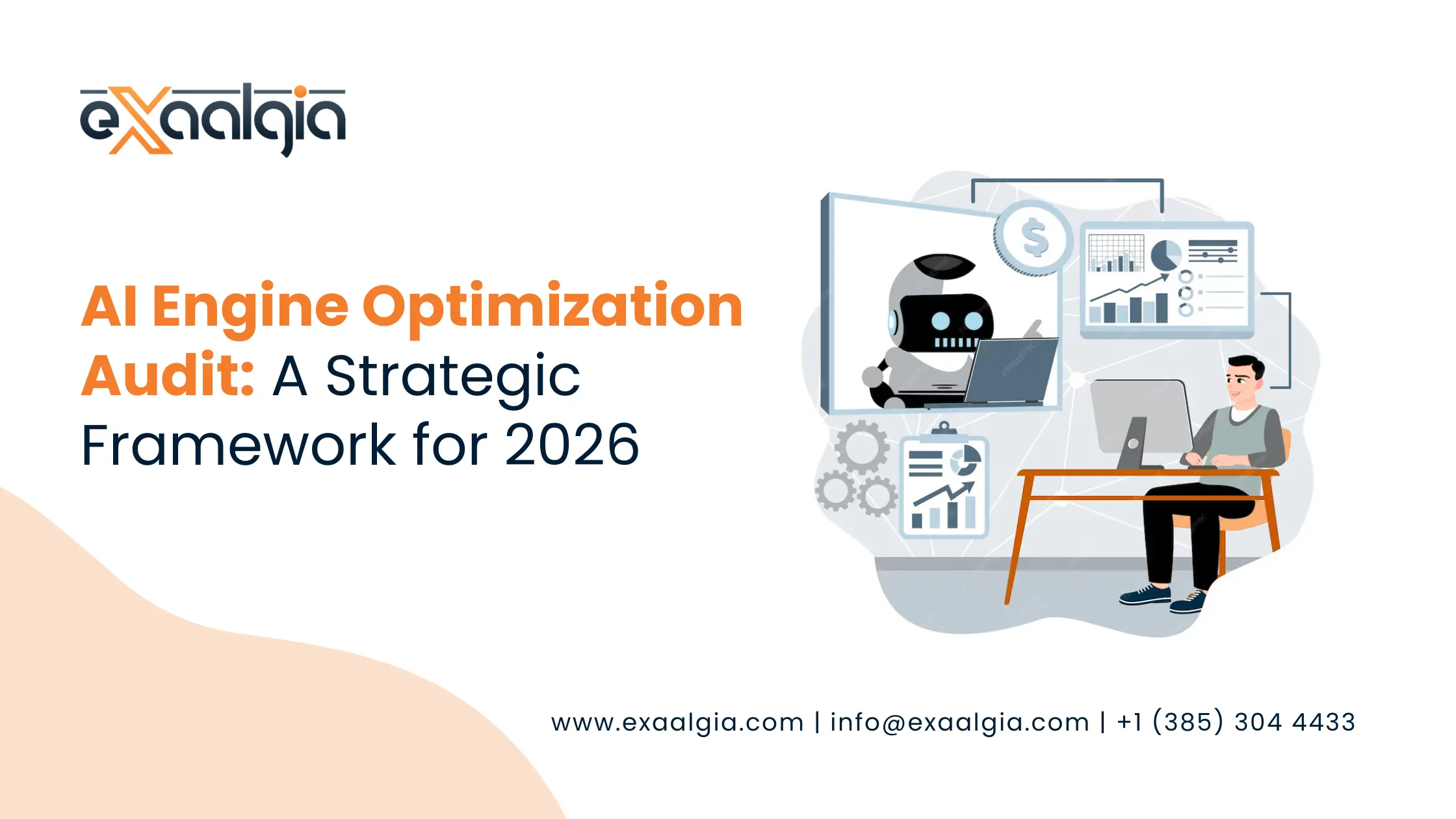
The complete professional guide explains how to conduct an AI engine optimization audit which helps businesses maintain their authority in the AI-powered business environment.
Let’s Demystify AI Engine Optimization Audit
An AI engine optimization audit is a systematic evaluation of how AI models perceive, categorize, and recommend your brand. Unlike a traditional SEO audit that focuses on keyword rankings and backlinks, an AEO audit analyzes the “LLM sentiment” and the accuracy of information these engines provide about your business.
It involves checking if your brand is being cited as a solution to user queries and ensuring that the data being fed into these models is factually correct. Essentially, it is a health check for your brand’s “digital twin” in the world of generative AI.
Why Now Is the Critical Moment for AI Engine Optimization Audit?
The shift from “scrolling through links” to “receiving a direct answer” is happening rapidly. If you aren’t auditing your AI presence, you are essentially letting the algorithms define your reputation without your input.
AI’s Expanding Role in Top-of-Funnel Engagement
In the past, users clicked on multiple blogs to gather information. Today, they ask an AI engine for a summary. If your brand isn’t part of that summary, you lose the opportunity to enter the user’s consideration set during the crucial discovery phase.
AI as a Silent Advisor in Buying Committees
B2B buyers of today complete their research process before they approach sales representatives. They use AI to compare software, services, and reputations. The audit process confirms that your brand will be presented with accurate value propositions when a buying committee requests information about the best service provider for specific needs.
Misinformation Amplifies in AI Search
AI models experience two major issues which include “hallucinations” and the use of outdated training data. Your credibility gets damaged through the use of an old office address or a defunct product line or an incorrect pricing structure. Regular auditing helps you spot these inaccuracies before they become “facts” in the AI’s memory.
AI Visibility as a Revenue Attribution Metric
Attribution is becoming harder. When a lead comes in saying they “found you on ChatGPT”, your marketing team needs to know how that happened. Auditing allows you to track your “share of model” and link AI visibility to your actual revenue pipeline.
AI Authority Is Built, Not Bought
AI models learn from patterns. The sooner you optimize your content for clarity and entity relationship mapping, the more deeply embedded your brand becomes in the model’s knowledge base. Early movers in AEO will enjoy a significant competitive advantage.
How to Audit Your AI Presence the Right Way
Establish Your Core Brand Entities
Before testing, identify what you want to be known for. List your core products, key executives, and unique methodologies. These are your “entities.” AI understands relationships between entities better than isolated keywords.
Evaluate Your Presence Across Leading AI Platforms
Activate the Open ChatGPT, Perplexity, Gemini and Claude applications. Use prompts like “What does [Company Name] do?” or “Who are the top competitors for [Niche]?” to check if your brand appears in the results and to assess the existing narrative.
Document Every AI Response
Document the responses. Are they positive, neutral, or negative? Are they citing your website or a third-party review site? Categorizing these helps you identify if your problem is a lack of content or a lack of third-party authority.
Create an AI Performance Index
Rate the AI’s performance. Does it provide a link to your site (a citation)? Is the description 100% accurate? This quantitative scoring allows you to measure improvement in future audits.
Find Semantic Weaknesses in Your Content
If the AI thinks you provide “Marketing Consulting” but you actually provide “SaaS Analytics,” there is a semantic gap. This usually means your website’s language is too vague for an AI to categorize correctly.
Optimize Content Architecture for Generative Search
Check your technical foundation. Use clear headers, bullet points, and “What is” sections. AI engines prefer content that is easy to parse and provides direct answers to specific questions.
Build AI-Optimized Supporting Content
You need to change your content strategy by using answer-based formats for future content development. Your website needs to establish its niche through three specific types of content which include FAQ sections and glossary pages and detailed guides.
Compare Before and After AI Performance
Utilize specialized tools to get a third party perspective on your progress. This provides a benchmark against industry standards.
High Impact Actions After Your AEO Audit
Once the audit is complete, prioritize these actions to improve your AI engine optimization audit score:
1: Fix your brand story before AI gets it wrong. Ensure your “About Us” and “Product” pages use consistent, factual language.
2: Build pages AI can confidently cite. Create dedicated pages for your main services that act as the “source of truth” for crawlers.
3: Improve content architecture for AI clarity. Implement schema markup (Organization, Product, FAQ) to give AI engines a roadmap of your data.
4: Create buyer focused supporting content. Write deeply informative pieces on topics where the AI currently lacks information about your brand.
5: Audit and update your external brand presence. AI trusts Wikipedia, LinkedIn, and major industry journals. Ensure your profiles there are up to date.
6: Increase earned media to strengthen authority signals. Pursue guest posts and PR. The more high-authority sites mention you, the more “confident” an AI becomes in recommending you.
A Practical AI Audit Review Framework
- Identified primary brand entities and “niche” descriptors.
- Tested brand queries across 4+ major LLMs.
- Verified accuracy of brand history, pricing, and services.
- Checked for the presence of citations/links back to the website.
- Implemented Schema Markup on key landing pages.
- Updated third-party profiles (G2, Crunchbase, LinkedIn).
- Created an FAQ section targeting long-tail conversational queries.
Frequently Asked Questions
Q: How often should I perform an AEO audit?
A: Since AI models are updated frequently and “browse the web” in real-time, a quarterly audit is recommended for most mid-sized brands.
Q: Is AEO different from traditional SEO?
A: Yes. SEO focuses on ranking in the Top 10 blue links. AEO focuses on being the source used by an AI to generate a single, definitive answer.
Q: Can I pay AI engines to show my brand?
A: Currently, most LLMs are organic and based on training data or real-time search. However, “AI-powered ads” are beginning to emerge in engines like Perplexity.
Q: Which semantic keywords are important for AEO?
A: Focus on “Natural Language Processing (NLP),” “Entity-based search,” “Knowledge graphs,” and “Predictive search intent.” Integrating these concepts into your strategy improves how engines crawl your site.