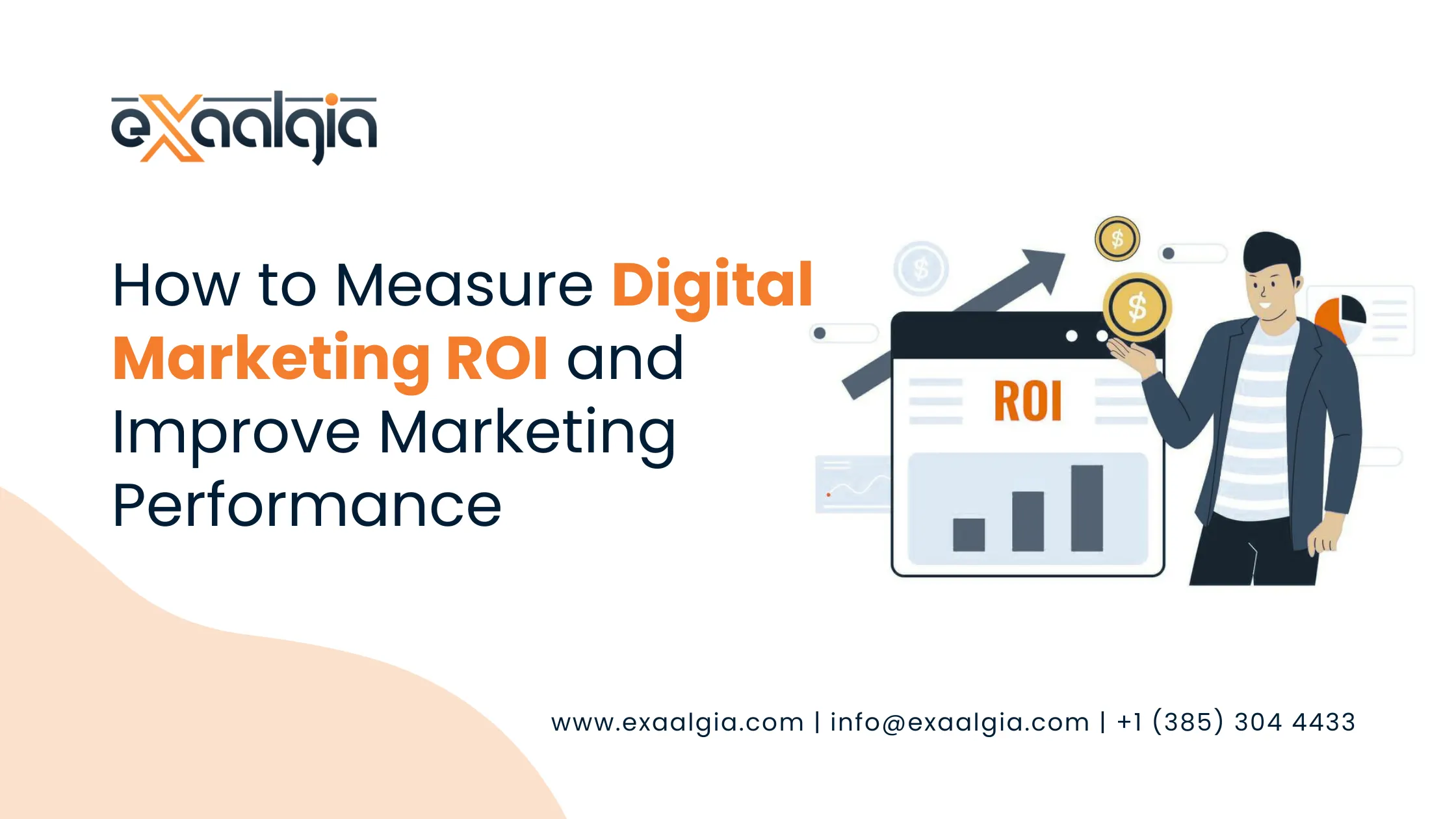
No matter if you are putting money into SEO, paid ads, content marketing, or social media, knowing your return on investment allows you to legitimize budgets, improve strategies, and expand what is effective.
This manual will clarify the real meaning of digital marketing ROI, the right measurement, the difficulties that are typically confronted by marketers, and the practical tips to enhance it not only in 2026 but also in the future.
Digital Marketing ROI Explained for Businesses
Digital marketing ROI measures how much revenue or value you generate from your marketing efforts compared to how much you spend on them. Unlike traditional marketing, digital channels offer deeper tracking, attribution, and optimization opportunities.
What Does ROI Mean in a Digital Context?
At its core, ROI answers one question:
“Are my marketing efforts profitable?”
The basic ROI formula is:
ROI = (Revenue – Cost) ÷ Cost × 100
However, digital marketing ROI goes beyond revenue alone. It can also reflect:
- Lead generation value
- Customer acquisition efficiency
- Brand visibility and engagement
- Lifetime customer value (LTV)
Why Digital Marketing ROI Is More Complex Than It Looks
Digital marketing involves multiple touchpoints, organic search, paid ads, email, social media, remarketing, and more. Customers rarely convert after one interaction, which makes attribution and measurement more nuanced.
That’s why modern ROI measurement focuses on:
- Multi-channel attribution
- Customer journey analysis
- Data-driven decision-making
Why Measuring Digital Marketing ROI Is Essential
Measuring ROI is not an option anymore, it is a prerequisite for sustainable growth. Here are the three most important reasons for this.
1. More Effective Budget Distribution
Knowing the channels which provide the highest ROI is the key to:
- Increasing the investment in campaigns with the best performance
- Elimination of the ads that generates no sales
- Focusing on the driving strategies that have an actual business impact
2. Marketing Accountability Improvement
Marketing ROI is a method that connects directly marketing activities with business outcomes. It is no longer a problem:
- To get sales and marketing aligned
- To show the marketing value to those who have invested
- To transform marketing from a “cost center” to an income generator
3. Continuous Performance Enhancement
Measuring ROI enables you to:
- Spot the weakest areas in the sales process
- Boost the number of customers who buy your product
- Experiment, refine, and scale the winning strategies all at once
How to Measure Digital Marketing ROI Using the Right Metrics
“Likes” and “Shares” are not enough to understand your performance, so you need to take a look at the ten metrics that really matter from all angles.
Conversion Rate: It is the total number of visitors expressed as a percentage who do what is desired (i.e. purchase, sign-up, or download).
Cost Per Lead (CPL): The amount of money you spend in order to obtain a potential customer’s information.
Customer Acquisition Cost (CAC): The sum of all costs (advertising + general administration) to convert a prospect into a customer who pays for the product.
Customer Lifetime Value (CLV): The total income that a company can expect to receive from a single customer account during the period of their relationship.
Return on Ad Spend (ROAS): The metric that literally means the revenue generated for each dollar spent on advertising.
Average Order Value (AOV): Seeing if your marketing is making customers spend more with every transaction.
Click-Through Rate (CTR): This shows the degree of attractiveness of your ads and organic listings to the target audience.
Bounce Rate & Engagement Rate: In 2026, if your content engagement is very high, that means it is very relevant and this, in turn, helps lower ad costs hence, indirectly boosting ROI.
Attribution Value: By the application of models (Linear, First-touch, or AI-driven), one can find out which channels played a part in the final sale.
Churn Rate: Especially for SaaS and subscription services, knowing how many customers you lose is crucial for calculating net ROI.
ROI Measurement Best Practices for Digital Marketing
It can be quite chaotic to measure ROI if there is no framework in place. Adhere to the following professional standards:
1. Objectives and KPIs Should be Clearly Defined
It is necessary to state the expected outcome before a campaign is launched. Would you prefer instant sales, or are you producing a list of leads for the top of the funnel? Your ROI calculation should be in harmony with your particular business objectives.
2. Include Multi-Touch Attribution
The road to making a purchase is seldom straight. An individual might first notice an Instagram ad, then read a blog post about the product, and only then make a purchase through a Google search. Advanced attribution modeling should be applied to give credit to every interaction.
3. Utilize Comprehensive Analytics Tools
Stop treating different platforms separately. Try to view everything from the “big picture” perspective with tools like Google Analytics 4 (GA4) or sophisticated CRM integrations. Make sure that your CRM and advertising platforms are in sync to enable “closed loop” reporting.
4. Include All Expenses in Your Calculations
One of the most frequent errors is the counting of “ad spend” only. To arrive at a real ROI, it is essential to include costs related to content creation, agency charges, software licenses, and the total time spent on the campaign.
How Different Marketing Channels Impact ROI
Different strategies result in different types of returns. The small details are the ones that you should understand:
Search Engine Optimization (SEO)
SEO is a long term strategy. Even though the “cost per acquisition” is usually lower than paid ads in the long run, the return is still delayed. On the contrary, once you get a good rank, the organic traffic gives a return that will keep on compounding for a long time.
Pay-Per-Click (PPC) Advertising
PPC gives the most instant return. It can be measured and scaled very easily. The problem that marketers will face in 2026 will be the increasing cost-per-click, which will make high conversion rate optimization (CRO) very important to keep the business profitable.
Content Marketing
The return from content is through brand authority and lead nurturing. Top notch whitepapers or videos may not generate a sale right away, but they do shorten the “sales cycle”, so your overall marketing becomes more efficient.
Social Media Marketing
Social media ROI in 2026 will be influenced greatly by “Social Commerce.” The direct integration of shops within such platforms as TikTok and Instagram has made tracking the dollar value of a social post easier.
Limitations of Measuring ROI in Digital Marketing
These obstacles will be met even with the most effective tools at your disposal:
Privacy Regulations and Data Gaps: The phasing out of third-party cookies and the implementation of more stringent GDPR/CCPA regulations have severely limited the tracking of users online. Henceforth, marketers have no choice but to collect and utilize “first-party data.”
The “Dark Social” Effect: A large portion of recommending and sharing activities takes place in the private channels (WhatsApp, Slack, Email) that tracking pixels cannot reach, thus becoming the “dark social.”
Offline Conversions: For brick and mortar businesses, the technical challenge of online ad to store purchase attribution still remains.
Actionable Steps to Improve Digital Marketing ROI
If your current ROI is not up to par, then it is high time for you to use these six tactics:
A/B Testing Everything: Regularly carry out testing on your headlines, images, and Call-to-actions (CTAs). A tiny increase in conversion rate results in big returns in ROI.
Focus on High-Intent Keywords: Reallocate your budget towards “buying” keywords instead of just “informational” ones to seize the users who are ready to spend.
Improve Website Speed and UX: A delay of one second in page loading time may cost you a lot in terms of conversions. Give the mobile user a perfect experience.
Leverage Email Marketing Automation: Keeping a current customer costs five times less than getting a new one. Set up automated flows to bag more lifetime value from your present list.
Utilize AI for Predictive Analytics: AI tools will help you to know which part of your audience is ready to buy and direct your budget to that segment.
Video Content Dominance: By 2026, video will have the highest engagement rate. At the moment, short video content is the most cost-effective in terms of reach and recall.
Scale Your Marketing ROI With Exaalgia’s Expertise
Accountability to any marketing activity is challenging if not impossible without a knowledgeable partner who sees the light and aspects of data as well as the idea behind it. Exaalgia is above all a company that is not only saying “getting clicks” but also “making money”. With the help of our geniuses, high-performance search engine optimization, pay-per-click directing and conversion rate optimization are all available with the 2026 digital economy in mind. We ensure that you do not spend on unnecessary things and at the same time, the tactics that really improve your profit are maximized.
Digital Marketing ROI FAQs for Businesses
How to define a “Good” ROI in Digital Marketing?
Depending on the sector the 5:1 ratio (5 dollars of revenue for each dollar spent) is generally regarded as strong. A 10:1 ratio is regarded as outstanding.
When will we see the ROI from SEO?
Normally, 4 to 6 months are needed to see the major changes in organic traffic and rankings, but the ROI generally gets the peak after 12-month perfect practice.
Is Social Media “Likes” counting as ROI?
Not at all. Likes are the metrics for vanity only. They show that there is engagement but do not guarantee that there will be a return in financial terms. ROI has to always be related to the business growing, for instance, by coming in as leads or going out as sales.
Tracking of ROI is not possible without a large budget, right?
No! It is not! Small businesses can actually end up getting a higher percentage of ROI than big companies with large budgets by using free tools like Google Analytics and targeting niche audiences who have high intent.