
The quality score metric in Google Ads stands as both a highly effective measurement tool and a common source of confusion for users. You must learn ad performance score because it enables you to achieve lower costs per click while increasing your competitive position and maximizing your advertising spending.
What Is Quality Score in Google Ads?
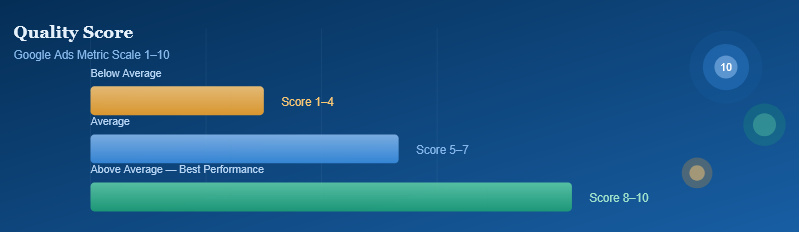
Google assigns quality score as a diagnostic metric which it uses to evaluate your Google Ads keywords with scores that range between 1 and 10. The system assesses how well your advertisements and keywords and landing pages serve users who view your advertisement. Google uses ad quality rating to give advertisers better ad placements and reduced advertising costs when their score reaches a higher level.
Internal rating system that Google uses to evaluate advertising quality functions as a Google system which benefits both Google and the users who view advertisements. When users find ads genuinely relevant the entire system improves because users receive better results and advertisers achieve higher return on investment while Google’s platform gains additional trustworthiness. Your ability to succeed in competitive auctions depends on your PPC campaigns.
“Quality Score is essentially Google’s way of telling you: ‘Is your ad actually good for the person searching?’ The better your answer, the less you pay to reach them.” — Google Ads Guide
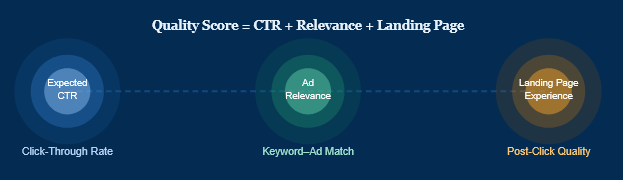
The Three Components of Ad Quality Rating
The ad performance score system used by Google depends on three main factors which determine its assessment. The rating system for each factor uses three levels which are Above Average, Average and Below Average.
| Component | What It Measures | Weight in Score | Status Example |
| Expected CTR | How likely users are to click your ad when it’s shown for a given keyword | Most significant factor | Above Average |
| Ad Relevance | How closely your ad copy matches the intent behind the keyword | Moderate weight | Average |
| Landing Page Experience | How useful, relevant, and easy-to-navigate your landing page is after the click | Significant long-term impact | Below Average |
Three components work together to create your quality rating which then determines your Ad Rank that controls your ad placement on search results. A successful digital marketing strategy requires constant maintenance of its three essential pillars.
Why Quality Score Matters for Your Ad Budget
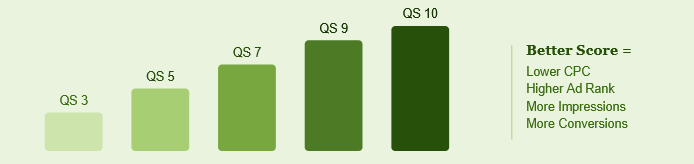
Ad performance score directly influences two essential results which include Cost Per Click and Ad Rank. A higher score means that you will spend less money to achieve the same advertising position or you will reach a better advertising position at the same expense.
| Quality Score | CPC Impact | Ad Position Effect | Recommendation |
| 1-4 (Poor) | +400% or more above average CPC | Very low ad visibility | Immediate overhaul needed |
| 5-6 (Average) | Normal market rate CPC | Moderate ad placement | Optimize for improvement |
| 7 (Good) | ~16% below average CPC | Good positioning | Maintain and refine |
| 8-10 (Excellent) | Up to 50% below average CPC | Top ad positions | Scale and replicate |
Pro Tip: Moving a keyword from a quality score of 5 to 8 can reduce your cost per click by 30-50%, effectively doubling your reach without increasing budget. This is why smart PPC management focuses on score improvement before bid increases.
7 Proven Ways to Improve Your Ad Performance Score
To improve your ad quality rating, you need to implement systematic work throughout your entire campaign. The seven strategies below represent the most effective methods for achieving success.
01
Tighten Keyword
Ad Alignment
Include the exact keyword in your ad headline and description. Google checks this match closely for ad relevance scoring.
02
Use Small, Tightly Themed Ad Groups
Group 5–10 closely related keywords per ad group (SKAGs or STAGs). Broad groups dilute relevance.
03
Write High-CTR
Ad Copy
Use numbers, benefits, strong CTAs, and emotional triggers. A/B test headlines continuously to lift expected CTR.
04
Optimize Landing Page Speed
Pages loading under 2 seconds dramatically improve landing page experience scores. Use Google PageSpeed Insights regularly.
05
Add Negative Keywords
Remove irrelevant search terms from triggering your ads. Higher relevance = better CTR and Quality Score across all matched searches.
06
Use All Ad
Extensions
Sitelinks, callouts, and structured snippets increase your ad’s real estate and click probability, boosting expected CTR.
The seventh strategy, which holds the most significant influence, requires businesses to create landing page content that matches their target keywords. Your ad quality rating and conversion rate will decrease when users search for “affordable PPC services in USA” but reach your generic homepage. The page needs to align its main title, written material, and call to action with the exact search term which users have entered.
“Quality Score improvement is not a one-time task, it’s an ongoing discipline. The advertisers who treat it as a continuous process consistently outperform those who only fix it when campaigns underperform.” — PPC Campaign Optimization
Common Ad Quality Rating Mistakes to Avoid
Bidding a lot more to offset low quality scores – It is an expensive trap. Remedy the problems of irrelevance rather than pay bad jobs.
Broad match keywords without control – Broad match will show an excessively large number of irrelevant searches and will impact both your CTR and your landing page relevance.
Overlooking mobile landing page experience – Mobile landing page kills your landing page score with 60%+ of all searches on mobile taking place.
Absolute traffic to the home page – Have dedicated, theme specific landing pages in each campaign.
Do not look at the report of search terms – This report is what people typed. And it is the closest way to eliminate irrelevant traffic and increase CTR.
How to Check Your Ad Performance Score in Google Ads
You can easily check ad quality rating through a simple process. In Google Ads, navigate to the Keywords tab in your campaign, then click the Columns icon and add “Quality Score,” “Expected CTR,” “Ad Relevance,” and “Landing Page Experience” to your view. The system provides complete keyword information which helps you determine which aspect requires your greatest focus.
Exaalgia’s team performs ad performance score audits as part of their complete pay per click management services. Your scores need to reach 7 before you can achieve actual progress through a structured improvement plan whose results will show within 30 to 60 days. Our digital marketing solutions will enhance your advertising performance according to our research.
Frequently Asked Questions
What is a good Quality Score in Google Ads?
A score of 7 or above is generally considered good. The scores which range from 8 to 10 demonstrate excellent ad relevance which results in lower CPCs and improved ad placement.
Does ad performance score directly affect my ad budget?
Your Ad Rank depends on both your ad quality rating and your bidding amount. A higher ad performance score means you can achieve better ad positions while paying less per click than competitors with lower scores.
How long does it take to improve ad quality rating?
You can achieve measurable results between 2 to 6 weeks through focused optimization which includes your current activities of improving ad copy and tightening ad groups and upgrading landing pages. The system requires sufficient impression data for new keywords before their scores will reach a stable state.
Is ad quality rating used in Performance Max campaigns?
ad quality rating measures performance for search campaigns which use keyword based advertisements. Performance Max evaluates ads through multiple signals yet considers ad relevance and landing page quality as essential components for assessing asset performance.