Landing page personalization functions as a growth advantage because it enables businesses to achieve more than they would with generic solutions.
The guide provides comprehensive information about what data should be collected and which audience groups should be established and which AI technology will transform operations and which effective methods should be used. The goal of this project involves creating clear content which delivers relevant information to users while enabling them to track their performance progress.
What Does Landing Page Personalization Really Mean?
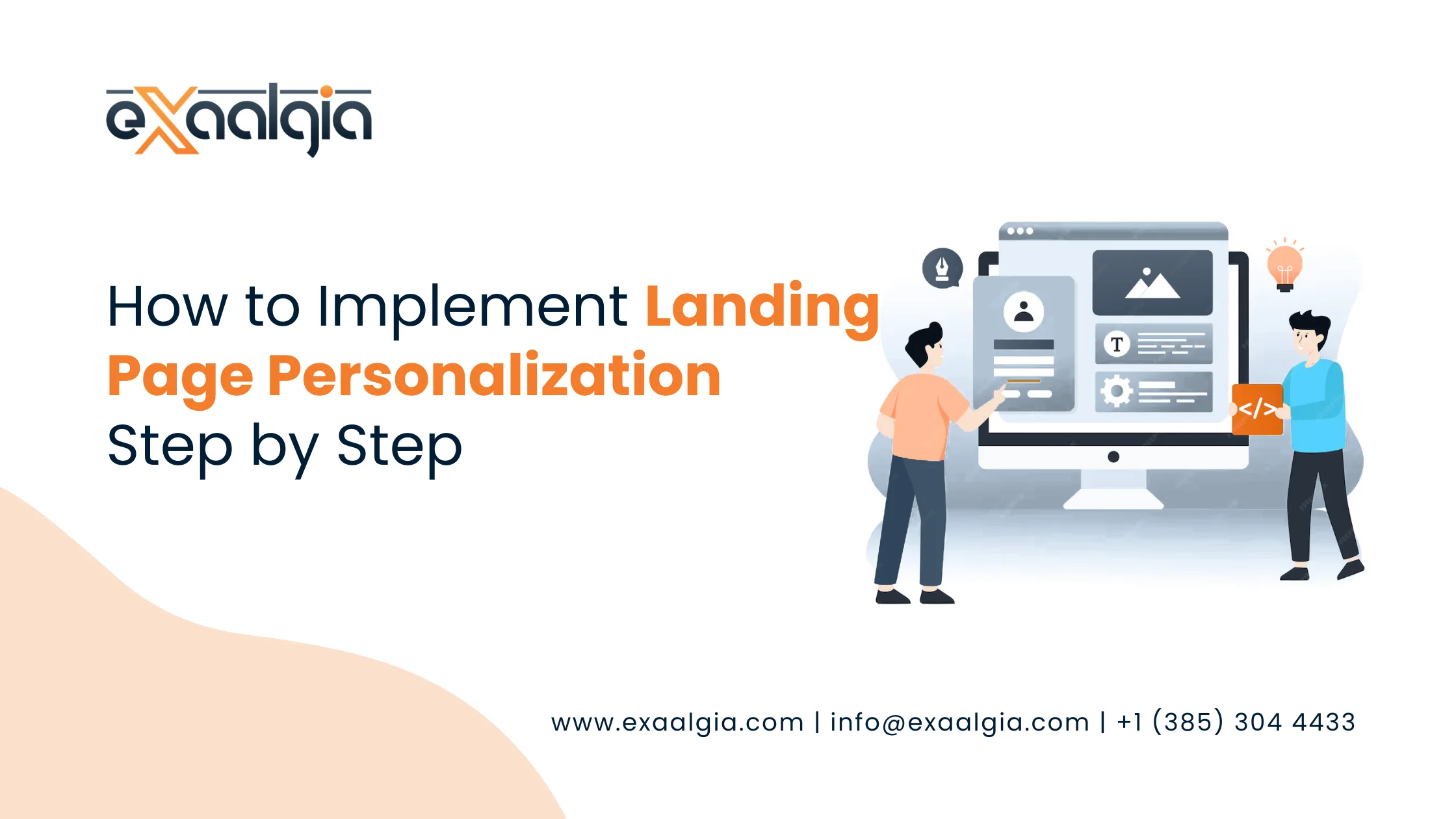
Landing page personalization involves creating custom web pages which display different content, messages, visual elements, special offers and call to action buttons based on the user’s identity and their methods of arriving at the page and their expected requirements.
Instead of showing the same headline and CTA to everyone, you customize elements like:
- Hero messaging
- Call to action buttons
- Testimonials
- Offers and incentives
- Layout and visual hierarchy
At its core, it aligns message to moment.
For example:
- A visitor from a Google Ads campaign sees messaging aligned to the ad copy.
- A returning SaaS user sees upgrade focused CTAs instead of beginner resources.
- A visitor from the healthcare industry sees industry specific case studies.
This isn’t just customization. It’s contextual marketing.
And when done correctly, landing page personalization increases relevance, reduces friction, and shortens the path to conversion.
Why Personalized Landing Pages Drive Sustainable Growth
Personalization isn’t a trend. It’s performance driven strategy. Let’s break down why it matters in practical terms.
Boosting Conversion Rates Through Targeted CTAs
When your headline matches the visitor’s intent and your CTA speaks directly to their goal, conversion rates increase.
Generic CTA:
“Get Started”
Personalized CTA:
“See How Our Platform Helps Marketing Teams Scale Campaigns”
Relevance reduces cognitive effort. When people don’t have to interpret whether your solution applies to them, they act faster.
Reducing Customer Acquisition Costs with Personalization
Paid traffic is expensive. If your landing page doesn’t reflect the ad promise or search intent, you waste budget.
Personalized messaging improves:
- Quality Score (for paid ads)
- Conversion rates
- Cost per acquisition (CPA)
By improving post click alignment, you increase return on ad spend without increasing traffic volume.
Reducing Bounce Rates with Relevant Content
Visitors bounce when they don’t feel understood.
Personalized content improves:
- Time on page
- Scroll depth
- Click through to secondary pages
- Micro conversions
When users see messaging that reflects their context, industry, location, or problem, they explore further.
Driving Revenue with Better Customer Alignment
Personalization filters the right leads.
Instead of attracting everyone, you attract:
- High-intent prospects
- Qualified decision-makers
- Industry-specific buyers
This improves lead quality, sales velocity, and customer lifetime value.
Continuous Improvement Through Data-Driven Testing
Personalized pages allow modular testing.
Instead of testing entire page redesigns, you test:
- Industry specific headlines
- Segment based offers
- Source aligned CTAs
You gain sharper insights because you test within segments, not across mixed traffic.
Key Inputs for Smart Landing Page Personalization
Personalization only works when powered by meaningful data signals. The key is using signals that reflect real intent.
1. Personalizing by Acquisition Channel
Understand:
- Paid search keyword
- Social campaign
- Email campaign
- Referral source
If someone clicks an ad about “enterprise analytics,” don’t send them to a generic homepage style landing page.
Align:
- Headline with keyword
- Offer with campaign goal
- CTA with buyer stage
2. Personalizing Based on User Behavior
Track:
- Pages viewed
- Time spent
- Content downloads
- Previous visits
If someone visited pricing three times, they likely need validation, not education. Show testimonials, case studies, or ROI-focused messaging.
3. Leveraging CRM Data for Personalization
For returning leads, CRM data becomes powerful:
- Job role
- Industry
- Company size
- Lead score
Instead of generic copy, speak directly to “Operations Managers at SaaS Companies.”
This increases perceived relevance instantly.
4. Location-Based Landing Page Personalization
Location data allows:
- Currency display
- Localized testimonials
- Regional compliance messaging
- Local event invitations
Small adjustments, like mentioning a city or country, create psychological familiarity.
5. Personalizing Based on Engagement Signals
If someone clicked a specific email topic, align the landing page with that topic.
For example:
- Email about automation → Landing page emphasizes automation benefits.
- Email about compliance → Landing page focuses on security and regulation.
Continuity improves trust.
6. Personalizing for Active Users
For SaaS businesses, in-app signals are gold.
You can personalize based on:
- Features used
- Feature gaps
- Usage frequency
- Upgrade eligibility
For example:
- Heavy usage → Show upgrade plan benefits.
- Low usage → Show onboarding support resources.
Stop Guessing – Use These Personalization Tactics
Knowing the data is one thing. Executing effectively is another. Let’s explore practical tactics.
1. Increase Conversions with Smarter CTAs
The call to action might be the most powerful element for personalizing websites.
Personalize by:
- Funnel stage
- Industry
- Campaign goal
- User intent
Examples:
- “Download the Healthcare Compliance Guide”
- “Start Your Free 14-Day Trial”
- “Book a Demo for Enterprise Teams”
Small wording changes can dramatically impact conversion rate optimization.
2. Crafting Headlines That Reflect User Intent
The hero section sets the tone. It should reflect the visitor’s problem, not your product.
Instead of:
“We Provide Advanced Marketing Solutions”
Use:
“Scale Your B2B Lead Generation Without Increasing Ad Spend”
Better yet, segment it:
“For SaaS Companies Looking to Reduce CAC by 30%”
Clarity beats cleverness.
3. Targeted Social Proof That Builds Trust
Businesses receive basic social proof through generic testimonials which create slight trustworthiness. Targeted testimonials, on the other hand, deliver stronger social proof by reinforcing relevance, credibility, and confidence in your brand.
Segment testimonials by:
- Industry
- Company size
- Use case
A healthcare prospect wants to see healthcare validation, not an eCommerce case study.
4. Dynamic Page Layouts Based on Intent
Not every visitor needs the same depth.
Top of funnel visitors:
- Need education
- Prefer explainer sections
Bottom of funnel visitors:
- Need pricing clarity
- Want ROI calculators
- Look for implementation details
Dynamic layout adjustments improve user experience without redesigning the entire site.
5. Custom Offers for Different Buyer Stages
Different segments value different offers.
Examples:
- Enterprise → ROI calculator
- Startup → Free trial
- Consultant → Playbook download
- Operations leader → Implementation checklist
Align the offer with urgency and buyer maturity.
6. Custom Visual Assets for Better Engagement
Visuals reinforce identity.
You can personalize:
- Industry imagery
- Dashboard screenshots relevant to use case
- Location-based visuals
- Team size representation
People connect faster when they see themselves reflected in the page.
The Right Way to Audience Segmentation for Personalization
Strategic audience segmentation should be executed for better results to avoid overwhelming situations. The team needs to concentrate on high-impact variables which drive intent, behavior and conversion results instead of attempting to customize for every potential variation.
High-ROI Segmentation Models for Landing Pages
1. Segmenting by Industry and Role
This is often the highest ROI segment.
Why it works:
- Pain points differ by industry
- Decision criteria vary by role
- Budget authority changes across functions
Tailor messaging to:
- Marketing managers
- Operations leaders
- IT decision-makers
- Founders
Each has a different lens.
2. Channel-Based Audience Segmentation
Traffic source tells you intent.
Paid search = High intent
Social media = Discovery
Email = Nurtured interest
Organic search = Problem research
Personalize based on motivation, not just demographics.
3. Segmenting by Buyer Journey Stage
A new visitor and a returning demo attendee should not see the same content.
Segment by:
- Awareness
- Consideration
- Decision
1. For awareness: Educate.
2. For consideration: Compare and validate.
3. For decision: Remove friction.
Automate Personalization Through AI
Historically, personalization required developers, complex rule engines, and constant manual testing. Today, AI-driven marketing tools like Unbounce, Landingi, Jasper simplify the process.
How AI Use Cases for Landing Page Optimization
Scaling Content Creation with AI
AI can generate:
- Segment specific headlines
- Industry focused subheadings
- Personalized email to page continuity
This reduces production time dramatically.
Predict High-Converting Content Suggestions
AI analyzes user behavior and predicts:
- Which offer is most likely to convert
- Which CTA performs best for a segment
- Which headline resonates based on historical data
This turns guesswork into data-backed decision-making.
AI-Driven Audience Clustering
Instead of manually defining every segment, AI identifies hidden patterns:
- Behavioral clusters
- Engagement based groups
- High-value lead patterns
This improves targeting precision.
Intent-Based Content Swapping
AI systems can dynamically swap:
- Headlines
- Images
- Testimonials
- CTAs
In real time, based on intent signals and behavioral triggers.
Automated Testing at Scale
AI accelerates experimentation by:
- Running multiple variations simultaneously
- Allocating traffic dynamically
- Automatically optimizing winners
Testing becomes continuous instead of periodic.
Advanced Engagement Analysis
AI tools evaluate:
- Scroll behavior
- Click patterns
- Micro-conversions
- Exit intent
Then adjust content in response.
The result is smarter, self-optimizing personalization rather than static segmentation.
Frequently asked questions about landing page personalization
Is landing page personalization only for large enterprises?
No. Even small businesses can personalize based on traffic source, campaign, or basic CRM data.
Does personalization slow down website speed?
Modern tools use lightweight scripts and edge delivery methods. With proper implementation, performance impact is minimal.
How much personalization is too much?
If messaging becomes fragmented or confusing, it’s too much. Focus on 2–3 high-impact variables first.
What’s the easiest place to start?
Start with source-based personalization and CTA adjustments. These deliver fast results with minimal complexity.
How do you measure success?
Track:
- Conversion rate
- Bounce rate
- Cost per acquisition
- Engagement metrics
- Lead quality
Personalization as a Growth Lever
Personalization requires Think Beyond dynamic landing pages. The process requires matching user intent with suitable messages and matching users with appropriate value propositions.
The strategic implementation of landing page personalization enables organizations to achieve better conversion rates through the use of relevant data signals and precise audience segmentation and advanced testing methods.
The organization achieves better results through the implementation of customer experience improvements.
Digital competition enables businesses to gain their strongest edge through their ability to maintain relevant digital presence.