
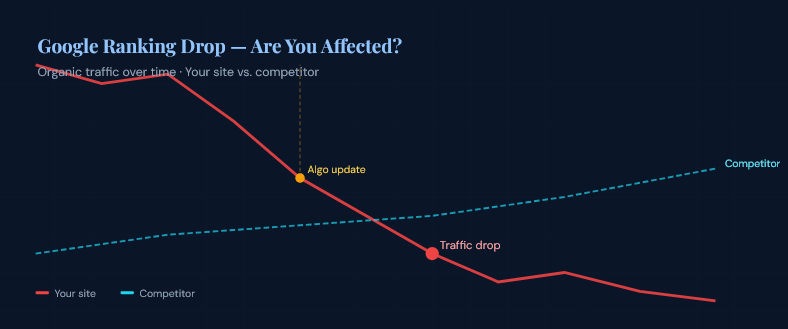
You open Google Search Console one morning and your heart sinks because your organic traffic has decreased by 40% since the previous day. A sudden Google ranking drop creates stress for small business owners, digital marketers and experienced SEO professionals because it represents one of the most challenging situations they face in digital marketing.
The good news? Almost every ranking drop has a diagnosable cause, and a fix. In this comprehensive, SEO optimised guide, we will walk you through the top reasons why your site drops in Google search results, how to diagnose the problem, and exactly what to do to recover.
91%
of web pages get zero traffic from Google
75%
of users never scroll past page one
3–5x
More traffic from position #1 vs #5
Google ranking factors
1. Google Algorithm Update
Google makes thousands of small tweaks to its search algorithm each year, and several major “core updates” that can shake entire industries overnight. If your traffic dropped suddenly, the very first thing to check is whether a Google algorithm update coincided with that date.
Our goal is simple: we want our algorithms to identify content that is both trustworthy and useful. Content should be written for people, not for search engines. — Google Search Central Documentation
The major updates of Google Helpful Content Updates and Core Updates and Spam Updates create direct effects on websites that use thin content and keyword stuffing and inefficient user experience. Your website needs to show E-E-A-T (Experience Expertise Authoritativeness Trustworthiness) to achieve permanent online stability.
Most Impactful Google Algorithm Updates
- Core Updates – Judge overall content quality and page relevance. Poor quality pages are hit hardest.
- Helpful Content Update – AI-generated or people-first content failures are penalised.
- Spam Updates – Target link schemes, scraped content, and cloaking.
- Page Experience Update – Rewards fast, stable, mobile-friendly experiences.
Tool tip: You need to compare your traffic drop date with Moz Algorithm Change History and Google’s Search Status Dashboard to determine whether an update resulted in the traffic drop.
2. Google Manual Action (Penalty)
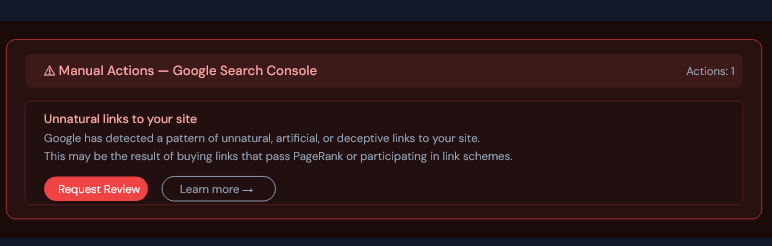
Google manual actions are different from algorithm changes because a human Google reviewer will issue a manual action when your website breaches Google’s Webmaster Quality Guidelines. The ranking drop scenario represents one of the most severe ranking drop scenarios because it produces both immediate and direct effects.
When you receive a manual action Google penalties will result in ranking losses from Google while Bing and Yahoo will continue to show your website. The official Google Manual Actions page provides complete instructions to help you fix manual actions.
MANUAL ACTION - QUICK FACTS
Checking: Google Search Console > Security and Manual Actions > Manual Actions.
Examples: unnatural links, skinny content, cloaking, hidden text, user-generated spam.
Result: Repair the problem, and create a Reconsideration Request in Search Console.
Average review period: 2-6 weeks upon submission.
3. Technical SEO Issues
Technical SEO errors operate as hidden threats which damage website rankings. The entire ranking system of a website would collapse because of one configuration error. Our team at Exaalgia frequently finds these issues during SEO audits for new clients.
A misplaced noindex tag on your homepage can wipe out all your rankings overnight, no algorithm change required. – Exaalgia SEO Team
Common Technical SEO Issues That Cause Ranking Drops
Accidental noindex tag -Developer pushed staging site’s robots.txt to live
Broken canonical tags – URL canonicalised with incorrect URL being leaked link equity.
Problems with migration between HTTP and HTTPS – Redirect chains or mixed content warnings.
Crawl budget waste – Googlebot wastes time on useless pages which are not of value.
Structured information errors – Rich snippets are removed in SERPs.
301 redirect loops or chains – Squandering link equity over unnecessary hops.
XML sitemap errors – Indexed pages or lack of significant URLs.
This official guide from Google about debugging search traffic declines serves as the main resource which we recommend following to establish a systematic debugging method.
The complete technical audit service is available through our professional SEO services which will discover and resolve all technical problems that prevent your website from achieving optimal performance.
4. Backlink Loss
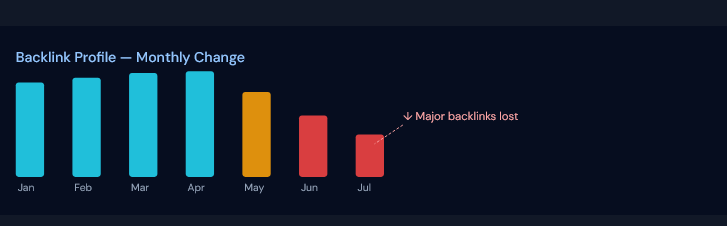
Backlinks serve as one of Google’s strongest ranking indicators. Your domain authority and website rankings decrease when high-authority websites remove their links to your pages or when their permanent links stop working.
Common causes of backlink loss include: referring domains shutting down and editorial content removal and link-building agencies using black-hat tactics that get algorithmically devalued and competitor pages earning the same editorial links.
How to Monitor and Recover Backlinks
- Monitor the changes in referring domains monthly using Ahrefs or SEMrush.
- Install notifications about lost backlinks of high-DA domains.
- Contact webmasters to get back broken or deleted links.
- Create a variety of enduring connections with content marketing and PR.
Our digital marketing and consulting services comprise an on-going monitoring of backlink profiles and proactive in-bound marketing solutions.
5. Competitor Improvement
SEO functions as a zero-sum game because any improvements a competitor makes to their content or high-authority backlinks or site speed optimization will decrease your search rankings without any faults on your part.
What to look for in Competitor Analysis.
- Have they released new comprehensive guides, case studies or videos?
- Have they improved their domain authority or number of backlinks?
- Are they now aggressively bidding for more paid search?
- Have they redesigned their site to be more UX friendly or performer friendly?
To achieve superior performance against competitors in both organic and paid methods, we recommend combining SEO services with our SEM offerings to create a complete search solution.
6. Content Quality Problems
Google’s Helpful Content system awards websites which provide genuine user assistance while it penalizes websites which exist only to achieve higher search engine rankings. The three main content-related elements which harm search engine rankings are thin content and duplicate content and outdated information.
| Content Problem | Ranking Impact | Recommended Fix | Priority |
| Thin content (under 400 words) | High negative impact | Expand with research, FAQs, examples | Critical |
| Duplicate content across pages | Medium-High | Add canonical tags or merge pages | High |
| Outdated statistics or facts | Medium | Quarterly content refresh | Medium |
| No internal linking | Medium | Add contextual & related post links | Medium |
| Strong E-E-A-T signals | Positive lift | Add author bio, credentials, sources | High value |
| Proper keyword placement | Positive lift | Natural use in H2s, first 100 words, meta | High value |
7. Core Web Vitals & Page Speed
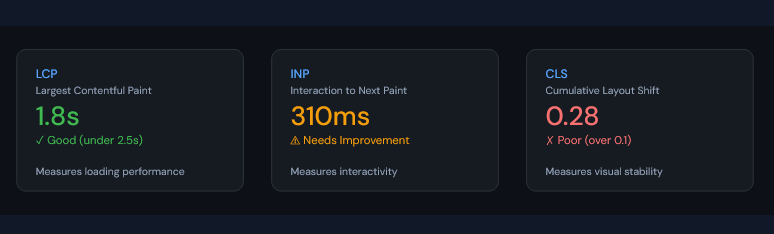
Google established Core Web Vitals as an official ranking factor in 2021. Sites that experience slow performance and visual instability and fail to respond to user interaction will receive lower search rankings when compared to their faster and stable competing sites particularly on mobile devices.
The 3 Core Web Vitals.
1. LCP (Largest Contentful Paint) – Measures loading performance. Target: under 2.5 seconds.
2. INP (Interaction to Next Paint) – Responsiveness. Target: under 200ms.
3. CLS (Cumulative Layout Shift) – Visual stability. Target: under 0.1.
Quick wins for improving Core Web Vitals, compress and serve images in WebP format, implement lazy loading for below fold images, remove unused JavaScript and CSS, use a content delivery network (CDN) and upgrade your hosting plan.
8. Mobile-First Indexing Issues
Google now primarily uses the mobile version of your website for indexing and ranking. The search engine will decrease your rankings if your mobile site contains different content or lacks structured data or has blocked resources or has broken layouts when compared to your desktop version.
- Ensure mobile and desktop content are identical in depth and quality.
- Use responsive design instead of creating separate m-dot subdomains.
- Team must check mobile pages to confirm accurate presence of structured data.
- Testing process will use the Mobile Usability report from Google Search Console.
Ranking Drop Diagnosis - Quick Reference Table
It will be of grate assistance if you refer to the given table and match your symptoms with what you consider the most probable causes and the fastest path to investigating them.
| Symptom | Likely Cause | Where to Check | Urgency |
| Sudden drop, all pages affected | Algorithm update | Search Console + Moz Algo History | High |
| Rankings gone on Google only, not Bing/Yahoo | Manual action penalty | Search Console > Manual Actions | Critical |
| Specific pages deindexed | noindex tag / robots.txt block | URL Inspection Tool in Search Console | Critical |
| Gradual decline over months | Competitor growth or link decay | Ahrefs, SEMrush backlink reports | Medium |
| Mobile rankings worse than desktop | Mobile-first indexing issues | PageSpeed Insights (mobile test) | High |
| Rich snippets disappeared from SERPs | Schema markup errors | Google Rich Results Test | Medium |
| Bounce rate increased sharply | Poor content match or UX issues | GA4 Engagement Rate reports | Medium |
Steps to Regain Rankings
For every notable drop in traffic or keyword position that you noticed, you must use a structured checklist regularly.
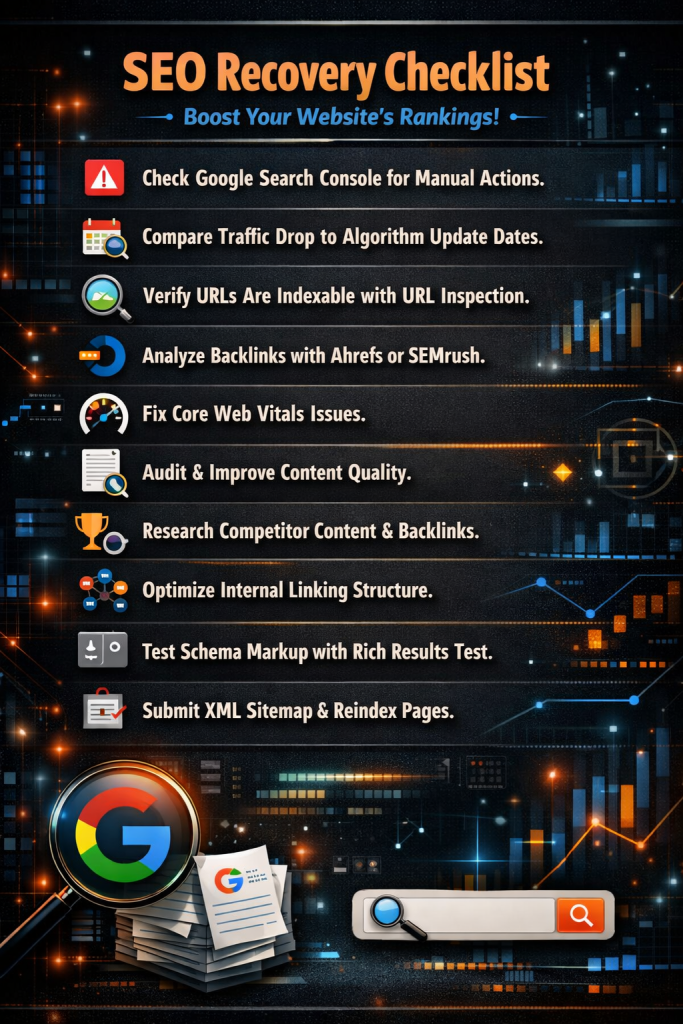
Rankings recover fastest when you address root causes, not just symptoms. Guesswork wastes months; a data-driven audit saves them. – Exaalgia Digital Marketing Team
Frequently Asked Questions
How long does it take to recover from a Google ranking drop?
The time taken to recover varies on the cause. Technical problems like accidental no-index tag can correct themselves in 1-2 weeks when fixed. Recovery times algorithm update usually require to the next core update cycle – typically 2 to 4 months. After placing a reconsideration request, it takes 2 to 6 weeks before manual action resolution is undertaken.
Can my rankings drop without me doing anything wrong?
Yes – When competitors have done a better job with their content, or received new high-DA backlinks or increased their site speed, your comparative advantage may slip even when your own site is not changed. SEO is a continuous competitive process and not a single set up.
What should I monitor weekly in Google Search Console?
Track these weekly: Performance report (by query and page, clicks and impressions), Coverage errors (newly blocked pages), Core Web Vitals status, and Manual actions. Check monthly sitemap status, crawl statistics and security problems.
Is paid search (SEM) a good backup during an organic ranking drop?
Absolutely. Running paid search campaigns in the interim of an organic recovery period will help you not to lose visibility and market share to competitors. One of the strongest search marketing methods in the contemporary search marketing is the combined SEO and SEM strategy.
Is Your Website Rankings Dropping?
Exaalgia’s SEO experts will perform a free technical audit, and provide you with a clear recovery roadmap.