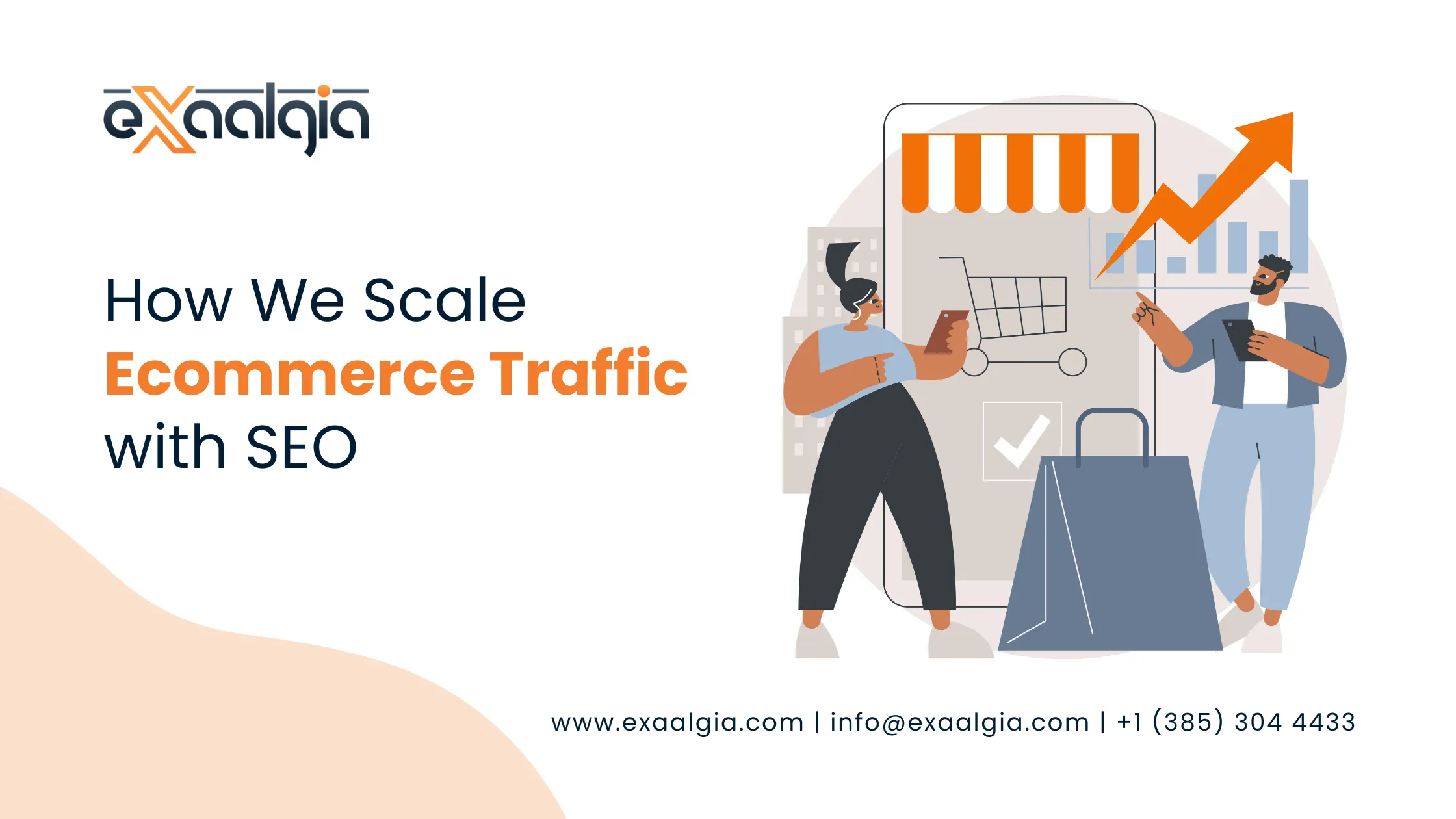
You have created an excellent online shop which you have stocked with high-quality items and which you have made available to customers around the world. Yet the traffic just isn’t coming. Do you recognize this situation? If so you are part of a common experience because a budget-friendly solution exists which does not require you to spend money on monthly paid advertisements.
Exaalgia has assisted ecommerce businesses from various sectors to achieve their organic growth objectives. Our guide presents the precise system which we utilize to increase ecommerce website traffic through search engine optimization because it provides effective solutions which generate cumulative results over extended periods.
68%
of online experiences begin with a search engine
53%
of all website traffic comes from organic search
14.6%
SEO lead close rate vs 1.7% for outbound
$6.5T
global ecommerce revenue projected by 2029
Why SEO Is the Smartest Long-Term Investment for Ecommerce
Relationship between paid advertisements and website traffic functions like a faucet because turning off advertisement expenses results in complete traffic cessation. SEO operates through a process that resembles a well-digging method because your results improve when you dig deeper into your SEO work. Your business achieves continuous success because every optimized webpage and each quality backlink and all your valuable content create ongoing value without incurring extra costs for every click.
The opportunity is enormous. The brands that succeed in organic search today will establish their strongest market position because global ecommerce revenue is projected to exceed six trillion dollars throughout 2029. Our ecommerce SEO services are built around exactly that philosophy.
The fundamental truth about ecommerce SEO: Your competitors are already ranking for the keywords your customers search every day. A well-executed SEO strategy doesn’t just bring traffic, it brings the right traffic, at the right moment, at a fraction of what paid channels cost per conversion.
Understanding Ecommerce Traffic Types Before You Optimize
Before building any strategy, it helps to understand what kinds of traffic exist because not all visitors carry the same value. The following section presents essential traffic sources which every ecommerce brand must handle and develop.
| Traffic Source | What It Is | SEO’s Role | Value |
| Organic Search | Visitors from Google/Bing via unpaid results | Core SEO channel | Very High |
| Direct | Users typing your URL directly | Brand SEO builds this over time | Very High |
| Referral | Clicks from links on other websites | Link building drives this | High |
| Social | Clicks from social media platforms | Content SEO amplifies this | Medium-High |
| Clicks from email campaigns | Supports returning visitors | Medium | |
| Paid Search | Google Ads, PPC campaigns | Complements SEO in the short term | Situational |
Our focus is on growing organic and referral traffic, these channels which produce monthly growth. A strong SEO strategy also naturally lifts your direct and social traffic because better content earns more shares which leads to increased brand searches and repeat visitors.
Step 1: Keyword Research That Maps to How People Actually Buy
Effective ecommerce keyword research starts with one question: what does your customer type into Google right before they buy? Most stores make excessive investments in general informational keywords while they spend insufficient resources on the specific search terms that lead to actual sales. We categorize every keyword by intent before assigning it to a page.
Transactional keywords: the highest purchase intent, with the first level of assignment to product and category pages, is transactional keywords, such as the “buy running shoes online USA”.
Commercial keywords: best wireless earbuds under 5000 – comparison-level queries, which are ideal in buying guides and category pages.
Informational: “how to choose running shoes” – top-of-funnel, used on content on the blog that feeds users into the purchasing funnel.
Navigational keywords: “Nike Air Max 2026” – brand defense, so that your own products are listed on your own pages.
| Intent Type | Example Query | Best Page Type | Priority |
| Transactional | buy wireless earbuds under 2000 | Product / Category page | Highest |
| Commercial | best wireless earbuds 2025 | Buying guide / Category | High |
| Informational | how to connect wireless earbuds | Blog post / FAQ page | Medium |
| Navigational | Sony WH-1000XM5 price | Product detail page | Brand defense |
Step 2: Fix Technical SEO Before Anything Else
Most brands make this mistake because they spend money on content and outreach work before they establish their basic operations. Technical SEO problems operate in the background to prevent your content from achieving its maximum potential. At Exaalgia’s SEO services, every engagement starts with a thorough technical audit.
Ecommerce SEO Checklist.
- Google able to index all product and category pages.
- Core Web Vitals passed: LCP less than 2.5s, FID less than 100ms and CLS less than 0.1.
- Mobile-first design – more than 60 percent of ecommerce is mobile traffic.
- SSL on all the pages, such as checkout and user account.
- Correctly set canonical tags on filtered, sorted and paginated URLs.
- XML sitemap that has been submitted to Google Search Console with all the indexable pages.
- Implemented structured data: Product, Review, and BreadcrumbList schema.
- Faceted navigation that is optimised to conserve crawl budget on extensive product lines.
- Soft 404s, redirect chains, and 404s that were completely fixed.
- Passing authority to important product and category pages by using internal linking.
A note on crawl budget:
Large ecommerce sites with thousands of SKUs are especially vulnerable to crawl budget waste from faceted navigation, the thousands of filter and sort URL combinations Google has no reason to index. Cleaning this up alone can dramatically improve how quickly new products get discovered and ranked.
Step 3: On-Page Optimisation for Product and Category Pages
Product pages are the points which convert SEO into revenue. The majority of stores either reproduce manufacturer descriptions which Google considers duplicate content or they create basic standard content which does not achieve search engine rankings. The complete on-page structure we use for our optimization work exists in this document.
| Page Element | What We Do | Common Mistake to Avoid |
| Title Tag | Primary keyword + brand + intent modifier (Buy, Best) | Using only the generic product name |
| Meta Description | Lead with unique value, include keyword, end with CTA | Auto-generated or completely empty |
| H1 Tag | Exact or close variation of target keyword | Internal product codes or SKU names |
| Product Description | 300+ words, benefits-first, LSI keywords used naturally | Copied manufacturer spec sheet verbatim |
| Image Alt Text | Descriptive, keyword-relevant alt tags on every image | Blank alt tags or filenames like img001.jpg |
| Schema Markup | Product + Review + Price schema for rich result eligibility | No structured data implemented at all |
| Internal Links | Link to related products, parent category, relevant blog posts | Pages sitting as isolated orphans with no links |
Step 4: Category Pages - The Traffic Goldmine Most Stores Ignore
Pattern we observe shows that brands allocate 90 percent of their SEO resources to individual product pages while they spend nothing on category pages. The correct approach requires businesses to direct their SEO resources toward category pages because these pages generate higher traffic by attracting more visitors who search for common keywords than any specific product page.
A properly optimised “Men’s Running Shoes” category page can achieve simultaneous ranking across multiple related search queries. Our five-step procedure establishes successful category pages that deliver optimal results.
- Add introductory copy (150300 words) above the product grid first keyword rich, but human-readable copy.
- Maximise H1 and H2 headings in the main category key and most valuable modifiers.
- Allow customer reviews and question and answer, customer-generated content will automatically add new, relevant content as time goes on.
- Connect content on blog posts to category pages to channel link equity where it matters most in the revenues.
- Introduce breadcrumb navigation using breadcrumb list schema to enhance the look and click through of SERP.
Step 5: Content Marketing as a Traffic Multiplier
A well structured content strategy does two things simultaneously because it enables businesses to attract potential customers who are not yet prepared to make purchases while establishing internal connections that boost their product and category page authority. We construct our content according to the pillar-cluster framework.
Purchasing lists – The “Best Laptops Under ₹50,000 in 2026” is commercial in nature and will be naturally linked to by review sites.
How-to information – “How to Choose the Right Running Shoes” – attracts early stage researchers and relates well to category pages.
Comparison posts – Product A vs Product B content moves mid-funnel shoppers that are about to make a decision.
Seasonal content – The round-ups of trendy items and festive sale guides posted 6-8 weeks before so Google can index them.
FAQ and long-tail content – Features voice search queries, featured snippets, and people also ask boxes in Google SERPs.
Step 6: Link Building - Authority You Can't Buy Overnight
Backlinks maintain their status as one of the most effective ranking signals which Google uses to determine website rankings. For ecommerce, a strategic link building programme can be the difference between page one and page three, especially in competitive product categories where content quality alone doesn’t separate you from rivals.
Quality over quantity, every time: A single backlink from a respected niche publication outweighs dozens of low-quality directory links. We focus on relevant, editorial links that signal genuine topical authority, not just domain count.
| Tactic | Effort Level | SEO Impact | Best Used For |
| Niche blogger outreach | Medium | High | Product reviews, roundup posts |
| Skyscraper content | High | Very High | Informational hub pages |
| Supplier / brand partnerships | Low | Medium | B2B or wholesale ecommerce |
| Digital PR campaigns | High | Very High | Brand authority building |
| Guest posting | Medium | Medium | Building topical relevance |
| Broken link building | Medium | Medium-High | Any ecommerce vertical |
Step 7: Measuring What Matters, KPIs Beyond Just Traffic
More traffic is a vanity metric if it doesn’t convert into revenue. Each ecommerce SEO engagement we follow has a particular performance metric associated with it that directly relates to business performance- not only position and sheer number of sessions.
- Organic sessions divided by the type of page: product vs category vs blog.
- Organic revenue and conversion rate of organic landing pages.
- Distribution of keyword ranking in position 1-3, 4-10 and 11-20.
- Impressions and click-through rate from Google Search Console, by page and query
- Pages covered by the XML sitemap vs pages in the indexed pages
- Pass rate of Core Web Vitals on mobile and desktop, monitored on a monthly basis.
- Referring growth Domain Rating monitored monthly.
- Search engine error rates and manual activity in Search Console.
SEO Is a Long Game Worth Playing
SEO is not a one-time event to level ecommerce traffic, it is a compounding investment. Each page which you optimize, each good backlink that you get and each useful content that you make available to your site turns out to be an asset that is there permanently. These resources do not need continuous investments in advertising. They don’t switch off at weekends. They are 24/7 and 365 days per year. It is upon this that the services of Ecommerce SEO come in, which enable businesses to establish a solid, long-lasting base of organic growth.
Brands that are leading in organic search may not always be the ones with the largest budgets. They are the first to get up early, remain steady and collaborate with experts who know the technical architecture as well as the creative strategy to long-term organic growth.