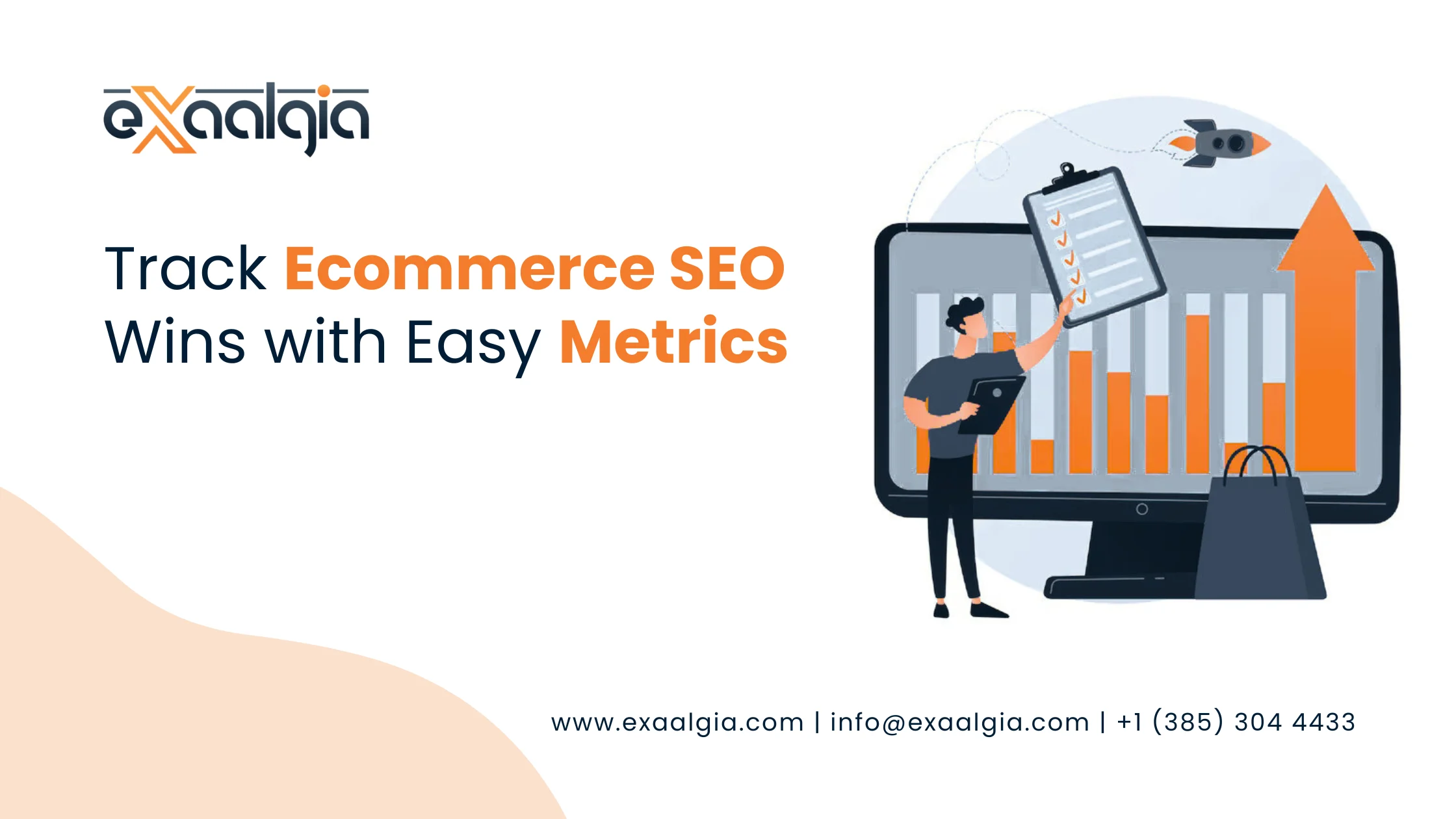
All retail businesses need to identify essential SEO performance indicators when they want to improve their online visibility from search engines. The guide provides details about essential ecommerce SEO tracking metrics which include their definitions and implementation procedures that require no data science expertise.
Exaalgia assists businesses with their SEO needs by providing solutions to their complex SEO requirements which they can implement for business success. Our ecommerce SEO services provide complete tracking and analysis services which will help your business grow through improved e-commerce search engine optimization.
Why Tracking Ecommerce SEO Metrics Actually Matters
Most ecommerce businesses invest in SEO but only a small number of them implement effective measurement methods. They examine overall website traffic while conducting monthly Google ranking assessments to complete their daily tasks. This leaves behind significant potential benefits through its current method of operation.
“You cannot improve what you do not measure. Tracking the right SEO metrics turns guesswork into a growth engine.”
Proper ecommerce SEO tracking helps you:
- See which product or category pages make you money
- Identify ranking issues before they affect your sales
- Demonstrate the value of SEO to key decision makers
- Decide where to focus your efforts and investment
- Compare your results with your competitors
It is never a question of collecting everything, but rather of collecting exactly what is needed, which is then to be used wisely to decide.
The Core Ecommerce SEO Metrics You Must Track
Not all metrics share the same level of value. Some metrics deliver only basic data, but other metrics provide crucial information that helps you make business decisions affecting your financial results. The following list shows the essential metrics which all ecommerce businesses need to track for operational success.
Key Performance Indicators Table
| Metric | Tracking Tool | What It Measures |
|---|---|---|
| Organic Traffic | Google Analytics 4 | Track sessions from search engines |
| Keyword Rankings | SEMrush / Ahrefs | Monitor position for target keywords |
| Conversion Rate | GA4 + Search Console | % of organic visitors who purchase |
| Bounce Rate | Google Analytics 4 | Single-page session percentage |
| Revenue from Organic | GA4 E-commerce | Direct revenue attributed to SEO |
| SERP Click-Through Rate | Google Search Console | Clicks ÷ Impressions × 100 |
| Domain Authority | Moz / Ahrefs | Site-wide authority score (0–100) |
Your SEO performance analysis requires individual assessment of each metric. Your base organic traffic metrics and sustainable ecommerce growth path become fully visible when you combine all three metrics.
Breaking Down the Most Impactful SEO KPIs for Online Stores
1. Organic Traffic Growth
What it is: Your store’s “free foot traffic.” It’s simply the number of shoppers who land on your site after typing a query into Google or Bing.
Why it matters: Every organic visitor is a potential buyer you didn’t have to pay for with ads. More traffic = more opportunities to convert.
How to track it: Head to Google Analytics 4 → Acquisition → Traffic Acquisition → Organic Search. Check the trend weekly—daily spikes or dips are usually just noise.
Healthy benchmark: Aim for a steady 15–25% month-over-month growth.
Quick win: Polish the titles, headings, and meta descriptions on your top 3–5 product pages.
Pro tip: Always split your data by device. If mobile isn’t driving at least 60% of your organic traffic, your mobile experience needs immediate attention.
2. Keyword Ranking Positions
What it is: Position of your product or category pages when you search your target keywords on Google.
Why it is important: The three first positions take up about 75 percent of all clicks. Below that is virtually unnoticeable by shoppers.
Tracking: Google Search console pull data to Performance Queries Average position. Free trackers such as Ubersuggest or SERPRobot are also effective. Target 10-15 priority keywords at a time.
Healthy benchmark: Be able to place at least 60% of your target key words in the top 10.
Quick win: Optimize your page titles by making them naturally incorporate your exact target keyword towards the beginning.
Pro tip: Use more keywords with commercial intent (buy, best, review, discount) rather than general informational keywords. Customers who search using such words already have their wallets in their hands.
3. Conversion Rate from Organic Traffic
What it is: The percentage of organic visitors who click on Checkout and make a purchase.
Why it is important: Traffic without sales is mere window shopping. This ratio will inform you whether your SEO is bringing the right buyers.
Tracking it: In GA4, navigate to Conversions Ecommerce Purchases, and then filter by Organic Search. Or determine it by hand: (Organic Orders/Organic Sessions) × 100.
Healthy benchmark: 2-3.5 percent in the majority of ecommerce niches.
Quick win: Include trust symbols and security labels and actual customer reviews directly above the “Add to Cart” button.
Pro tip: Compare this with your paid ad conversion rate. The organic ought to be nearly always more, since searchers are a clear buying intent.
4. Click-Through Rate (CTR)
What it is: The number of individuals that actually visit your listing after encountering it in search results.
Why it is important: You can have high rankings but people will avoid you when they scroll past. Click through rate will inform you whether your title and description are attractive to the point of getting the click.
Tracking method: Within Google search engine, in the search console, under the Performance section, go to the CTR column. Divide it by Impressions and multiply the results by 100.
Good mark: 3-5 percent in case you are in positions 1-3. 1–2% is normal for positions 4–10.
Quick win: Re-write meta descriptions to show a definite advantage, urgency, or selling point.
Pro tip: To activate rich snippets, include structured data (such as star ratings, pricing, or availability). They regularly increase CTR by 30 or even higher.
5. Page Load Speed
What it is: How many seconds does it take before your pages are completely rendered and become interactive.
Why it is important: Speed in ecommerce is not a luxury, but revenue generator. 53 per cent of mobile users give up on sites that take more than 3 seconds to load.
Tracking: Instant tests with Google PageSpeed Insights, or GA4 (Engagement → Page Speed) should be pulled. Check your homepage and top 5 product pages.
Normal benchmark: Less than 3 seconds on mobile, less than 2 seconds on desktop.
Quick fix: Image compress (convert to WebP format) and activate lazy loading.
Pro tip: Rankings and conversions are influenced by speed. Research indicates that conversions can be reduced by 7 percent with just a one-second delay.
6. Bounce Rate & Engagement
What it is: How many people visit your site and they do not click anything further. (Note: GA4 has since replaced this with the concept of Engagement Rate, however, the idea remains the same.)
Why it matters: High bounce = your page is not aligned to search intent, or the user experience is heavy in friction.
Tracking: Within GA4, go to Engagement and Bounce Rate. Note down a page that is over 65.
Healthy benchmark: Less than 45 percent on product pages. Blogs are extendable to 60 percent.
Quick win: Eliminate 2-3 internal strategic links to related products or collections in the first paragraph itself.
Pro tip: Bounce rate is not something to watch. Check average engagement time, it must be able to clear 45+ seconds on product pages. Otherwise, your text, photos, or design require a re-updating.
7. Revenue Attributed to Organic Search
What it is: The mean revenue each organic visitor earns to your store.
Why it is important: This is the macro metric that can be used to unite traffic, conversion rate, and average order value. It gets to the point: Are we making money with our SEO?
How to monitor it: Within GA4, you can find Monetization Monetization Revenue/Sessions, then use the filter organic search as a traffic source.
Healthy benchmark: Do not pursue a particular number. Pay attention to the trend- it needs to increase 10-15 percent per quarter.
Quick win: Upsell blocks on popular product pages (Frequently bought together or You might also like).
Pro tip: Segregate this by landing page. You will be able to see your lost sources of income in no time- and will be able to know just where to invest more in SEO efforts next month.
Setting Your SEO KPI Benchmarks & Targets
Yes, tracking can be detrimental if the metrics are not set in the first place. Here’s a good ecommerce KPI structure for your organization at various growth stages:
| KPI | Baseline | Target |
|---|---|---|
| Impressions Growth | 0–5K/month | >20K/month in 6 months |
| Avg. Position | Page 3–5 | Page 1 (Top 5) |
| Organic Sessions | 500/month | >2,000/month in 90 days |
| Product Page CTR | 1–2% | >5% with optimized titles |
| Revenue from Organic | $500/month | >$3,000/month in 1 year |
“The stores that win at ecommerce SEO are those that set clear benchmarks, review them monthly, and course-correct without hesitation.”
You should modify your targets according to three factors which include your industry and competition level and your present domain authority. New stores should focus on impressions and crawlability first; established stores should prioritize conversion rate optimization and revenue growth.
Technical SEO Metrics That Impact Ecommerce Rankings
Product page SEO success needs a strong technical foundation which goes beyond measuring traffic and revenue. Your store’s backend metrics determine how search engines will crawl your site and create indexes and establish ranking positions.
Core Web Vitals (LCP, CLS, FID/INP): page experience indicators at Google. Poor scores = prioritizing penalties, particularly on mobile.
Crawl Coverage: The proportion of the pages crawled by the Googlebot. Lack of coverage translates to missed indexing opportunities.
Index Coverage Errors: Pages that are blocked, noindexed or 4xx/5xx errors wasting crawl budget.
Site Speed (TTFB): Time To First Byte. The slowness of loading is detrimental to SEO ranking and conversion of users.
Structured Data / Schema Markup: The product schema, review schema, and breadcrumb schema are all known to enhance the visibility of rich snippets in SERPs.
Mobile Usability: Mobile first indexing means that any kind of mistakes on mobile directly affects the search results of your ecommerce store.
Execute a monthly technical audit through Google Search Console together with Screaming Frog or Ahrefs Site Audit. The team must fix all critical errors without delay because they will become worse over time.
How to Build a Simple Ecommerce SEO Dashboard
You can track SEO performance effectively without requiring an enterprise-grade analytics system. The following dashboard setup provides a basic yet free solution which works effectively with most ecommerce websites.
Connect Google Analytics 4 + Google Search Console – connect the two to have one source of organic traffic and keyword data.
Activate GA4 Ecommerce events – purchase event, add to cart event and begin check out event to identify revenue by channel.
Alternative: Use Looker Studio (free) – pull GSC + GA4 data into a live visual dashboard that your team can look at weekly.
Add a Rank Tracker – add SEMrush, Ahrefs, or Mangools to track the position of your best 20-50 target keywords.
Establish Monthly Review Schedule: schedule a monthly review to take place within 30 minutes to assess the existing measurements against those of the prior month and prior quarter.
Stop Guessing, Start Winning with Data Driven Ecommerce SEO
Tracking ecommerce SEO metrics requires more than a commitment to numerical data as its main focus. The process uses actual data to create faster decision-making improvements. The stores that compound their monthly SEO victories achieve success through their ongoing process of measurement and learning and optimization.
This guide provides you with actionable information about your store’s search performance through organic traffic metrics and keyword rankings and technical health scores and revenue attribution metrics. You should begin your dashboard construction by selecting three to five essential metrics and then proceed to add more metrics.
The good news?You can solve this problem without handling everything by yourself.
“Ecommerce SEO is a long game, but with the right metrics and the right team, every month you gain ground your competitors can’t easily recover.”
Ready to Track and Scale Your Ecommerce SEO Wins?
Here, you could get the experts to handle the setup and give you time to focus on running your store.